Fiberon vs Trex Enhance: Budget Composite 2026
The four boards that compete for every 'cheapest real composite' build — Trex Enhance Basics and Naturals vs Fiberon Good Life and Promenade — compared on price, warranty, retail access, and the fastener math nobody runs.
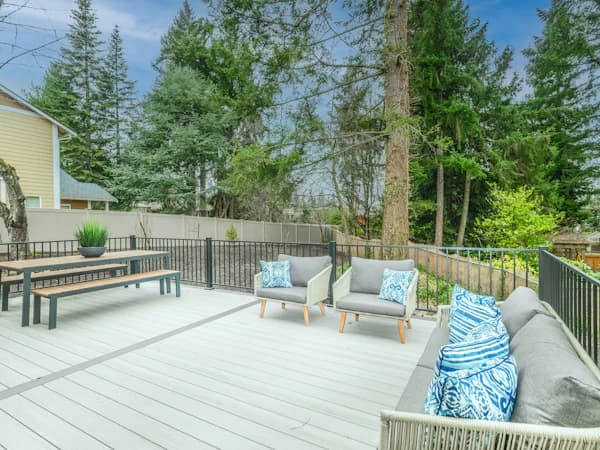
At the entry tier the numbers are close: Trex Enhance Basics runs about $3.30 per linear foot (≈$7.05/sq ft in boards), Fiberon Good Life $3.60 (≈$7.70), Fiberon Promenade $3.85 (≈$8.20), and Trex Enhance Naturals $3.95 (≈$8.45). All four carry 25-year structural and fade/stain warranties. The real differences are retailer, board profile, and fastener economics.
The 30-second answer
These four boards are engineered for the same buyer: someone stepping up from pressure-treated who wants capped composite at the lowest real price. Trex Enhance Basics is the cheapest board; Enhance Naturals adds wood-grain looks; Fiberon Good Life is the Lowe's-stocked DIY favorite; Fiberon Promenade is the grain-and-color step-up on the Fiberon side. Warranty can't break the tie — all four are 25 + 25.
| Spec | Trex Enhance Basics | Fiberon Good Life | Fiberon Promenade | Trex Enhance Naturals |
|---|---|---|---|---|
| Board price (per lf, retail) | $3.30 | $3.60 | $3.85 | $3.95 |
| Boards only (per sq ft) | ≈$7.05 | ≈$7.70 | ≈$8.20 | ≈$8.45 |
| Material | Capped composite, scalloped | Capped composite | Capped composite | Capped composite, scalloped |
| Structural warranty | 25 years | 25 years | 25 years | 25 years |
| Fade & stain warranty | 25 years | 25 years | 25 years | 25 years |
| Colors | 3 | 4 | 4 | 5 |
| Grooved for hidden clips | Yes | Yes | Yes | Yes |
| Big-box home | Home Depot | Lowe's | Lowe's / pro dealers | Home Depot |
Prices are 2026-Q1 retail averages (Home Depot, Lowe's, each brand's pro channel) — the dataset behind DeckMath's Trex Enhance and Fiberon calculators. Per-square-foot figures assume a 5.5″ board face + 1/8″ gap (≈2.13 lf per sq ft).
Where you'll actually find them
At this tier, availability decides more purchases than specs do. Trex Enhance is the Home Depot value composite — widely stocked, easy to see in person, easy to re-order mid-build. Fiberon Good Life is the Lowe's equivalent — its catalog positioning is explicitly DIY-friendly, and Lowe's is where you'll find boards on the shelf. Promenade and Enhance Naturals sit one notch up and are more often pro-desk or special-order items.
The practical advice mirrors what we concluded in the Trex vs TimberTech value-tier comparison: quality across the big-brand entry composites is comparable, so pick whichever your nearest store can hand you fastest — a mid-build two-week wait for three more boards is the real cost nobody prices in.
The hidden-fastener math nobody runs
All four boards are grooved for hidden clips, but the two brands' systems are priced very differently — and on a value build, fasteners are a visible slice of the budget:
| System | Box spec | Effective cost / sq ft | Cost on a 16×20 (320 sq ft) |
|---|---|---|---|
| Fiberon Stowaway | 175 clips · ~100 sq ft · $138/box | ≈$1.38 | 4 boxes ≈ $552 |
| Trex Universal Hidden Fastener | 90 clips · ~50 sq ft · $89/box | ≈$1.78 | 7 boxes ≈ $623 |
Fiberon's Stowaway box covers twice the area, which works out to roughly $0.40/sq ft cheaper — about $70 on a 16×20 deck, or most of the board-price gap between Enhance Basics and Good Life. The systems are not interchangeable: each clip is dimensioned for its own brand's groove, and mixing systems voids the warranty. Face-screwing with color-matched plug systems is the alternative on both brands (Trex plug packs ≈$28 per ~50 sq ft; Fiberon Phantom packs ≈$36 per ~50 sq ft).
A 16×20 deck, both ways
Using each brand calculator's national defaults for a 320 sq ft (16×20) deck with railing and 4 stair steps:
| Build | Boards only | Installed reference (national) |
|---|---|---|
| Trex Enhance Basics | ≈$2,250 | ≈$17,500 with railing + 4 stairs |
| Fiberon Good Life | ≈$2,460 | ≈$17,000 with railing + 4 stairs |
| Fiberon Promenade | ≈$2,630 | between the Good Life and Paramount references |
| Trex Enhance Naturals | ≈$2,700 | ≈$450 in boards above the Basics build |
Read that carefully: Basics wins on boards, but the Good Life reference build lands slightly lower installed — cheaper clips (Stowaway), a cheaper value railing on the Fiberon side (Symmetry ≈$58/lf installed, the same rate as Trex Enhance Railing), and slightly lower stair pricing (≈$285-425/step vs ≈$320-460). At this tier the ecosystem, not the board, decides the total. Regional labor then swings either total by ±30% (≈0.92× South to ≈1.28× West Coast).
Which should you pick?
- Absolute lowest board cost: Trex Enhance Basics — $3.30/lf is the cheapest current board from either brand, with the same 25-year warranties as everything else here.
- Lowest all-in project cost: run both calculators — the Fiberon ecosystem (Stowaway clips, Symmetry railing, cheaper stairs) often erases Trex's board-price lead on a full build.
- DIY install: either scalloped Enhance line (lighter boards to carry and cut) if Home Depot is your store; Good Life if Lowe's is — it's the line Fiberon positions specifically for DIYers.
- Best looks at the value tier: Enhance Naturals (5 nature-toned, grain-textured colors) or Promenade (wood-grain cap, 4 colors incl. Rosewood and Castle Gray) — the two 'step-up' boards in this four-way.
- Resale on a listing: Trex, marginally — it's the brand buyers recognize. Board performance won't differ enough to matter; condition will.
- Full sun with a dark color: none of these four — no entry-tier board from either brand has heat-mitigation tech. Go light on color, or budget up to Transcend Lineage or a PVC line.
Where this pricing comes from
Board, clip, railing, and stair prices are 2026-Q1 retail averages across Home Depot, Lowe's and each brand's pro channel — the same dataset behind DeckMath's Trex Enhance and Fiberon deck calculators, which also generate the 16×20 reference builds quoted above. Warranty terms are the manufacturers' published terms — verify at trex.com and fiberondecking.com before you buy. Per-square-foot conversions use a 5.5″ board face + 1/8″ gap (≈2.13 lf/sq ft). See our methodology and sources.
Frequently asked questions
Is Fiberon as good as Trex at the entry level?
At this tier they are genuine peers, and the spec sheets say so. Fiberon Good Life at about $3.60 per linear foot and Trex Enhance Basics at $3.30 are both capped composite, both grooved for hidden clips, and both carry a 25-year structural warranty plus a 25-year fade and stain warranty. Nothing in the coverage separates them, which is unusual in a category where brands normally compete on warranty length. What actually differs is retail presence and the surrounding system. Trex Enhance is the Home Depot value composite and Good Life is the Lowe's equivalent, positioned explicitly for do-it-yourself buyers. Fiberon clips cover more area per box, and Fiberon railing and stairs price slightly lower. So the honest answer is that quality is not the deciding variable here; availability and the cost of everything around the board are.
Which is cheaper, Fiberon or Trex Enhance?
It depends whether you are buying boards or building a deck. Board for board, Trex Enhance Basics is cheapest at about $3.30 per linear foot, roughly $7.05 per square foot, against Fiberon Good Life at $3.60, roughly $7.70. On 320 square feet that is a $210 advantage to Trex. The full build reverses it. Fiberon Stowaway clips cover about 100 square feet per $138 box against Trex Universal Hidden Fastener at about 50 square feet per $89 box, which is roughly $0.40 per square foot cheaper, or about $70 on the same deck. Add Fiberon Symmetry railing at a comparable rate and slightly cheaper stairs at about $285 to $425 per step against $320 to $460, and the reference 16 by 20 build lands near $17,000 in Good Life against $17,500 in Enhance Basics. Run both calculators before deciding.
Do Fiberon and Trex Enhance have the same warranty?
Effectively yes at the value tier. Trex Enhance Basics, Trex Enhance Naturals, Fiberon Good Life and Fiberon Promenade all carry a 25-year limited structural warranty plus a 25-year limited fade and stain warranty. Because the coverage is identical, warranty cannot break the tie between these four boards, and any sales pitch built on it is describing something that is not there. What does matter is your own paperwork. Both brands expect the warranty to be registered after installation, and both will ask you to establish what was installed and when if you ever claim, so keep the receipts and a note of the production batch. Terms are published by each manufacturer and do change, so confirm the current wording before purchase rather than relying on a comparison table, including this one.
Can I use Trex hidden fasteners on Fiberon boards?
No. Trex Universal Hidden Fastener clips and Fiberon Stowaway clips are dimensioned for their own brand's board groove, so mixing them is both a poor mechanical fit and an explicit way to void the board warranty. Buy the clip system that matches the board you bought. If you prefer to face-screw, both brands sell colour-matched plug kits for the purpose, with Trex plug packs at about $28 per 50 square feet and Fiberon Phantom packs at about $36 per 50 square feet. This is worth planning before you order rather than at the end of the job, because the fastener system is a visible slice of a value build. The clip difference alone, roughly $0.40 per square foot, is most of the board-price gap between the two brands, which is exactly the sort of detail a board-only comparison hides.
How much does an entry-level composite deck cost installed?
Using national defaults, a 16 by 20 deck of 320 square feet with value railing and four stair steps lands around $17,000 in Fiberon Good Life and around $17,500 in Trex Enhance Basics, which is roughly $53 to $55 per square foot installed. Boards are only about $2,250 to $2,460 of that, so the great majority of the bill is framing, railing, stairs and labour, none of which cares which brand you chose. Region moves the total more than brand does: the South runs about 8 percent below the national reference and West Coast markets up to about 28 percent above, a swing of roughly 30 percent on the same deck. That is the main reason two honest quotes for identical specifications can differ by thousands, and why a national per-square-foot figure is a sanity check rather than a budget.
Related calculators
Related guides
Get matched
Want 2–3 free quotes for this exact deck?
We'll send your plan to vetted local builders. Free, no obligation.