How to Build a Deck: 8 Steps, 6–12 Weekends (IRC 2021)
The complete process for building a residential deck — from permit to final inspection. Tools, materials, IRC code references, and the order in which professionals actually work.
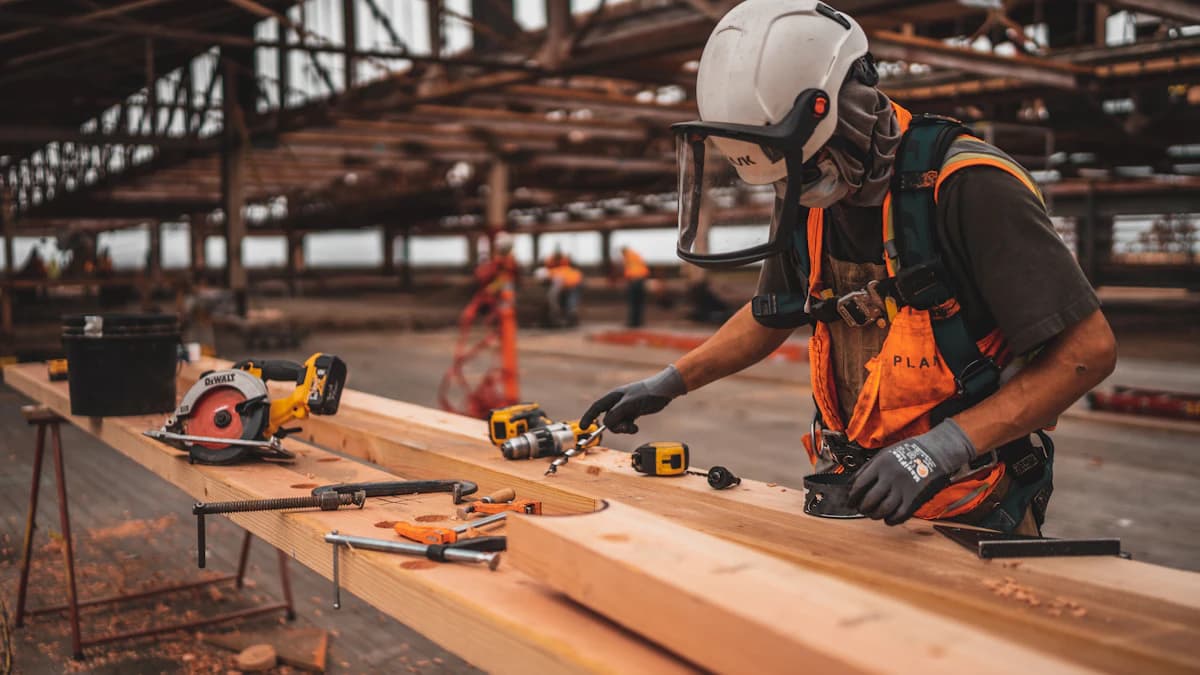
Building a deck is the single most achievable major DIY project on the typical American home — bigger than a kitchen reno (impossible), smaller than a house addition (still possible but exhausting), and exactly the size where a competent weekend carpenter saves $8,000-15,000 in labor on a 320 sqft build. This guide walks through the 8-step process used by professional deck contractors, with the tool list, the IRC code references, and the timing realities. Plan on 6-12 weekends for a first-timer and 4-6 weekends for someone who has framed before.
Step 1: Plan + permit (week 1-3)
Don't even buy lumber until you've pulled the permit. Order of operations:
- Measure the deck location. Note: setback distance from property lines, house wall length, doorway location, drainage slope.
- Sketch the deck shape — rectangle is cheapest and easiest, L-shape adds 10% complexity, multi-tier doubles the time.
- Run DeckMath's deck-material-calculator with your dimensions to get a permit-ready BoM with IRC code citations.
- Run DeckMath's deck-cost-calculator to set a budget.
- Submit permit application: site plan, construction plan, lumber spec, code references. Most AHJs respond in 1-3 weeks.
- While waiting on permit: order long-lead items (composite decking, railing systems often have 2-4 week lead times).
Step 2: Layout + footings (week 3-4, 1-2 weekends)
Mark the deck on the ground
Use mason's line + stakes to lay out the deck perimeter to scale. Verify diagonals are equal (square check). Mark every footing location with spray paint.
Dig footings
12-inch (or larger per your soil bearing) post-hole auger or hand-dig. Depth = local frost depth + 6 inches for bearing. In Minneapolis that's 60+6 = 66 inches deep. In Houston, 6+6 = 12 inches. Check IRC R403.1.4 (ICC) + DeckMath's deck-footing-calculator for your state.
Set sonotubes + pour concrete
Sonotube cardboard forms set to grade. Mix concrete to specified PSI (typically 2,500-3,000 psi for residential). Insert post anchor (Simpson ABU66Z) BEFORE concrete cures — anchors set into wet concrete bond stronger than retrofit anchors.
Footing inspection
Schedule the AHJ inspector before pouring concrete. They verify depth + diameter + soil bearing layer + (if required) rebar. Don't pour until they sign off.
Step 3: Ledger board (week 4, 1 weekend)
On attached decks, the ledger is the structural board bolted to the house framing. This is where most deck failures happen if done wrong.
- Remove siding in the ledger zone. Find the rim joist behind it.
- Cut + dry-fit ledger board (PT 2× the same depth as your joists — 2×10 joists = 2×10 ledger).
- Drill 1/2″ × 4-1/2″ lag bolt holes, 16″ o.c. staggered up + down per IRC R507.9.1.3. NEVER attach to brick or stone veneer — must be into wood structural framing.
- Install Z-flashing (aluminum) over the top edge of the ledger to prevent water entry. Tucks under siding above, drapes over ledger top.
- Install lateral-load anchors (Simpson DTT2Z) at 2 minimum per ledger — required by IRC R507.9.2.
- Replace siding around the ledger with proper drainage gap.
Step 4: Posts + beams (week 5, 1 weekend)
With ledger set + footings cured, install posts and beams.
- Cut 6×6 PT posts to height (deck top + ground - footing top). Set into ABU66Z post bases on the cured footings.
- Brace posts plumb with temporary 2×4 stakes.
- Cut beam stock — typically 2-ply 2×10 PT for spans up to 8-10 ft. Glue + nail (10d at 16″ o.c. staggered) the two plies together per R507.5.2.
- Set beams on top of posts. Use Simpson PC6Z post-to-beam caps to mechanically tie them.
- Verify beams are level and post-to-beam connections are tight.
Step 5: Joists (week 6, 1-2 weekends)
Joists are the 'floor' framing. Spacing depends on your decking material — composite needs 16″ o.c. parallel or 12″ o.c. diagonal; PT 5/4×6 can go 16″ o.c., PT 2×6 can go 24″ o.c.
- Cut joists to length (deck width + cantilever). Cantilever max = 1/4 of back-span per R507.6.
- Hang joists on ledger using Simpson LUS210 hangers (or LUS28 / LUS26 to match joist size). 10d nails or specified Simpson SDN screws — DO NOT use deck screws or framing screws in hangers.
- Set joists onto beam. Toenail or use Simpson H1 hurricane ties (mandatory in coastal hurricane zones).
- Install rim joists on ends + double the rim joist for stair landing locations.
- Add blocking — 2× scrap blocks between joists at the midpoint of long spans, prevents joist roll.
Framing inspection
Schedule before installing decking. Inspector verifies joist size + spacing, beam config, hangers, ledger bolts + flashing, lateral anchor, post bases. THIS is where most failures happen — fix before installing decking.
Step 6: Decking (week 7-8, 1-2 weekends)
The fun part — installing the actual deck surface. Process differs slightly between PT and composite.
Pressure-treated decking (face-screw)
Predrill (PT splits easily near edges). Use #8 × 2-1/2″ ceramic-coated deck screws, 2 per joist crossing. Maintain 1/8″ install gap between boards (use a 16d nail as a spacer).
Composite decking (hidden fastener)
Install joist tape over every joist (Trex Joist Tape, Trex Protect, or generic butyl tape) — protects joist from moisture trapped under composite. Run a starter clip at the wall edge. Set first board, install hidden clip per Trex Universal Hidden Fastener instructions, then nest next board into the clip. Repeat. Last board needs a face-screw with a Trex Hideaway plug. ~2 clips per joist crossing.
Edge trim
Composite: install fascia trim around perimeter (Trex sells matching fascia). PT: cap the rim joist with another PT 2×x
Step 7: Stairs (week 8-9, 1 weekend)
IRC R311.7 (ICC) governs stair geometry. The big rules:
- Riser height: max 7-3/4″, min 4″, every riser within 3/8″ of the others (R311.7.5.1)
- Tread depth: min 10″ + 3/4″ nosing on closed-riser stairs
- Stair width: min 36″ between handrails
- Handrail required on 4+ riser stairs, graspable 1-1/4 to 2″ diameter, 34-38″ above tread nosing (R311.7.8)
- Landing pad at bottom: 3'×3'×4″ thick concrete, level with bottom riser
Layout: total rise (deck top to grade) ÷ desired riser height = number of risers. Total run = (risers - 1) × tread depth. Cut stringers (typically 2×12 PT) using a framing square, install at width spacing (16″ o.c. for cut, 24″ o.c. for solid). Tread + riser boards go on top.
Step 8: Railing + final inspection (week 9-10, 1 weekend)
Required when deck is more than 30″ off grade (R312.1). Standard residential is 36″ minimum height; 42″ is required in some jurisdictions.
- Set posts at corners + every 6 ft along the perimeter. Use through-bolt to rim joist + 1/2″ × 5-1/2″ carriage bolts.
- Install top + bottom rails between posts.
- Install balusters: 4-inch sphere rule (R312.1.3) — every gap must reject a 4-inch sphere. DeckMath's baluster-spacing-calculator solves this exactly.
- Install graspable handrail on stairs (R311.7.8.1).
- Schedule final inspection. Inspector brings the 4″ sphere gauge.
Tools you'll need
Power tools (own or rent)
- Cordless circular saw — basic 6-1/2″ or 7-1/4″ ($100-200 for a good one)
- Cordless drill + impact driver kit (Milwaukee M18 or Dewalt 20V, $200-400)
- Miter saw (10″ minimum, $150-400) — speeds up tread + rail cuts
- Auger or post-hole digger (rent for $40-80/day)
- Pneumatic framing nailer (optional but speeds up everything)
Hand tools
- Framing square + speed square + 4-foot level + 25-ft tape
- Mason's line + stakes for layout
- Bubble level + post level (clip-on, $20)
- Chalk line + marker
- Hammer (16-20 oz framing) + rubber mallet (for board spacing)
Safety + comfort
- Safety glasses + work gloves (PT lumber splinters are nasty)
- Knee pads — you'll spend hours installing decking on your knees
- N95 mask for cutting PT (the chromated copper compounds are not lung-friendly)
- Sturdy boots + long pants (composite shavings cut skin)
Frequently asked questions
How long does it take to build a deck DIY?
For a 320 square foot deck, plan on 8 to 12 weekends as a first-timer, which works out to roughly 60 to 80 hours of actual labour. Someone who has framed before finishes in 4 to 6 weekends and 30 to 50 hours. Those figures cover swinging a hammer only, and the calendar is always longer than the labour. Most authorities having jurisdiction take one to three weeks to return a permit, composite decking and railing systems commonly carry two to four week lead times, and you will wait on two inspections that stop work until they happen: the footing inspection before you pour concrete, and the framing inspection before any decking goes down. Add it up and a realistic window from decision to final walk-through is 8 to 16 weeks. The single biggest schedule saver is ordering long-lead materials while the permit is still being reviewed rather than after it lands.
Can I really build a deck myself?
Yes, and a deck is the most achievable major project on a typical house: bigger than a weekend repair, smaller than an addition, and squarely inside what a competent weekend carpenter can finish. The skills that actually decide the outcome are narrower than people expect. Layout comes first, because squaring the deck with mason line and equal diagonals sets everything downstream, and an error there compounds through joists, decking and stairs. Ledger flashing comes second, because that detail is water management on your house wall rather than on the deck, and getting it wrong rots structure you cannot see. Cutting and fastening are the easy parts. The honest disqualifier is not intelligence but tool familiarity: if you have never run a circular saw, build something smaller first. The other disqualifier is scope, since a multi-tier deck or one more than 16 feet above grade leaves prescriptive code territory and needs an engineer.
What tools do I need?
The minimum kit is a cordless circular saw, a drill and impact driver, a framing square, a four-foot level, a 25-foot tape, mason line and stakes, and either a post-hole digger or a rented auger at about $40 to $80 a day. A good 6-1/2 or 7-1/4 inch circular saw runs $100 to $200 and a drill and impact set $200 to $400, which puts a first-timer total at roughly $400 to $800 including the small stuff. Three optional tools pay for themselves on a big deck: a 10-inch mitre saw at $150 to $400 for tread and rail cuts, a framing nailer for the joist work, and a pneumatic stapler if you are running joist tape for composite. Do not skip the safety items either. Safety glasses, gloves, knee pads for the hours spent on the decking, and an N95 for cutting pressure-treated lumber all belong on the list.
How much can I save by DIYing?
Materials are typically 40 to 50 percent of an installed deck price, so the labour you replace is the larger half of the bill. In practice a competent do-it-yourselfer with free weekends saves 50 to 60 percent of the total project cost. On a $20,000 contractor quote that is $10,000 to $12,000 kept, against roughly 80 hours of weekend work, or about $125 to $150 an hour for your time. For most homeowners that is two to three times what their day job pays, which is the real reason deck DIY is popular. Two caveats keep the number honest. First, you still pay for the permit, the inspections and any re-inspection fees, and tool purchases come out of the saving on your first deck. Second, the saving assumes the work passes. A framing mistake caught by the inspector costs a weekend; the same mistake caught after the decking is down costs several.
What is the order of operations?
Plan and permit, then layout and footings, then the ledger, then posts and beams, then joists, then decking, then stairs, then railing and the final inspection. That sequence is not a preference, it is what the inspection schedule and the physics enforce. Never pour footings before the permit is issued, because an authority can make you dig them up. Never pour concrete before the footing inspection, since depth, diameter and bearing layer are exactly what the inspector came to see. Never lay decking before the framing inspection, because covering the joists hides the hangers, ledger bolts, flashing and lateral anchors that the inspection exists to check, and pulling boards back up is the most demoralising rework on the project. Within that order there is one useful piece of flexibility: order long-lead composite and railing while the permit is in review, so the material arrives about when the framing is ready for it.
What is the easiest part of building a deck, and the hardest?
The easiest part is the decking itself. Once the framing is right, laying boards is repetitive work with a simple rhythm: gap them consistently at 1/8 inch, two fasteners per joist crossing on pressure-treated, or hidden clips nested board to board on composite. It is the stage that finally looks like a deck, and it goes quickly. The hardest parts are both at the start. Layout is hard because squaring the perimeter with equal diagonals is what every later measurement inherits, and being half an inch out of square is invisible until your last board runs tapered against the house. Ledger flashing is hard because it is the one detail where a mistake damages the house rather than the deck: Z-flashing has to tuck under the siding above and drape over the ledger top, or water tracks into the wall. Spend your extra hours on those two and the rest follows.
What if I make a mistake?
Most mistakes are recoverable, and the stage you catch them at decides the cost. A joist hung too high comes down by pulling the hanger nails and repositioning. A footing poured shallow can often be extended by another six inches on top. Inconsistent decking gaps are a matter of backing out screws and resetting boards against a spacer. The expensive category is structural sizing: a footing of the wrong diameter or a joist run past its allowed span means demolishing and redoing that section, because no fastening trick fixes an undersized member. This is the practical argument for treating the framing inspection as a free audit rather than a hurdle. Everything the inspector checks is still visible and reachable at that moment, and the same defect found after the decking is installed costs a weekend of removal before you can even start the repair.
Do I need to be licensed to build my own deck?
No. In all 50 states a homeowner may build a deck on their own property without holding a contractor licence. What you do need is the building permit, and with it the inspections that come attached: footing, framing and final. Permits are not optional for a structure of this size, and skipping one tends to surface later at the worst possible moment, when a buyer requests records during a sale or an insurer asks after an incident. Where the rule does bite is help. Unpaid help from friends or family is fine, but paid help generally has to be licensed, so you cannot hire an unlicensed labourer for the framing weekend. Rules vary by authority, so confirm locally before you plan around anyone else's hands. The permit application itself wants a site plan, a construction plan, lumber specifications and code references, which is why a calculator that outputs an IRC-cited bill of materials saves real time here.
What if my deck fails inspection?
Failing is common and rarely serious. The inspector writes up what is wrong, you fix it, and you schedule a re-inspection, which costs about $50 to $150 in most jurisdictions. The failures that recur are predictable: a missing lateral-load anchor at the ledger, hangers that are undersized or fastened with deck screws instead of the specified nails or structural screws, footings that did not reach frost depth plus bearing, and baluster gaps that let a 4-inch sphere through. Every one of those is a parts-and-a-weekend problem when caught at the framing stage. The way to make failure cheap is to invite it early. Book the footing inspection before you pour and the framing inspection before a single deck board goes down, so the items under review are still exposed. Most decks that fail the first time pass on the second.
Should I hire a contractor instead?
Hire out when one of four things is true. Your time is genuinely worth more than about $100 an hour, in which case the 80 hours is the expensive part of the project. You have never used a circular saw, since a deck is a poor place to learn. Your design leaves prescriptive code, which includes multi-tier decks and anything more than 16 feet above grade, because those need engineered design rather than the IRC tables a DIY build leans on. Or you live in a low labour-cost market, where the saving from doing it yourself shrinks against the risk. Outside those cases the arithmetic favours DIY for most homeowners, typically netting two to three times an average hourly wage. A middle path exists and is underused: hire a contractor for the ledger, footings and framing, then do the decking, stairs and railing yourself.
Related calculators
Related guides
Get matched
Want 2–3 free quotes for this exact deck?
We'll send your plan to vetted local builders. Free, no obligation.