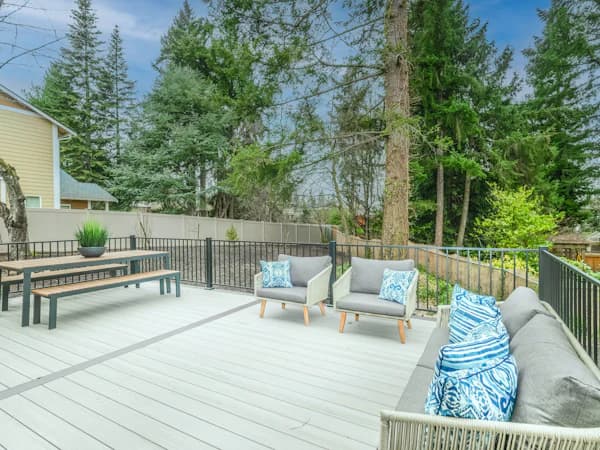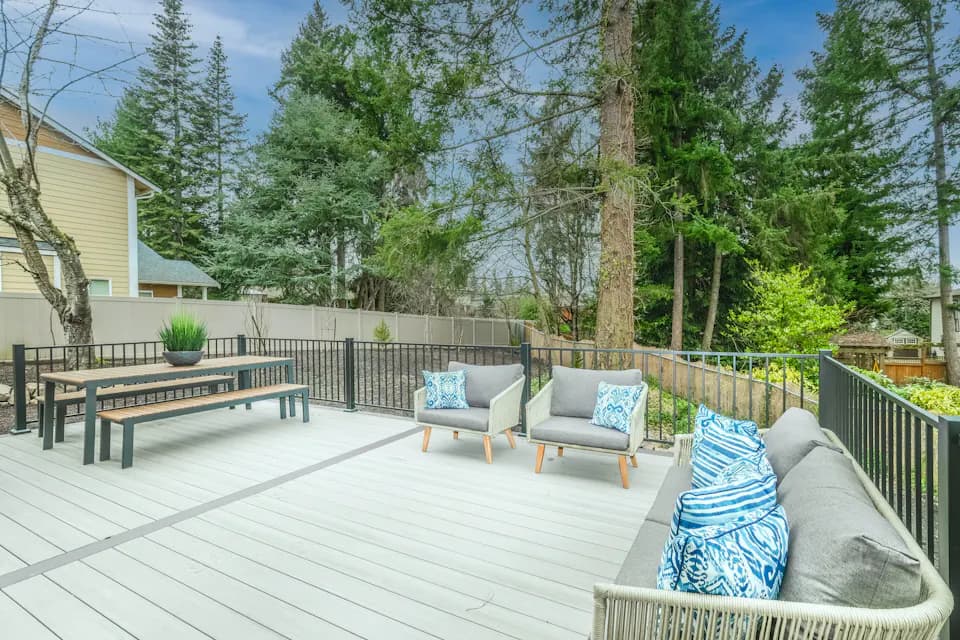
DeckMath
Composite Deck Cost Calculator

Your composite deck,
costed.

Trex, TimberTech, Fiberon, Deckorators, Wolf, MoistureShield, Veranda — pick a brand × line × color and get a real installed total broken down to the board, the clip, and the linear foot. Plus a 25-year cost-of-ownership chart vs pressure-treated wood.

  • No signup
  • IRC 2021 verified
  • 120+ calculators
  • Free forever
Typical 16×12 ft buildLive
Project budget · national median
from $16,566
$86–$128/ sq ft installed

Adjust size, material tier, state and scope below — the estimate and the 3D deck repaint instantly.

2026-Q1 contractor pricingAll 50 statesFree foreverNo signupLive 3D preview
Quick answer

How much does a composite deck cost in 2026?

A composite deck costs $40–$75 per square foot installed in 2026, including labor and hidden fasteners. Entry-tier lines (Trex Enhance, TimberTech EDGE) run $40–$55/sqft; premium PVC tiers (TimberTech Reserve, AZEK Vintage) reach $65–$85/sqft. A 12×16 (192 sqft) mid-grade composite deck averages $11,500 installed.
Entry / sqft
$40–$55
Premium / sqft
$65–$85
12×16 mid-grade
≈ $11,500

Inputs

= hot in sun · = stays cool

Dimensions

Plan-view length × width.

ft

ft

Area · 192 sq ft·Perimeter · 56 ft·Stocked in 12/16/20 ft
in

IRC R312 requires a 36″ guardrail above 30″.

192 sq ft Trex Enhance Naturals / Basics deck in Beach Dune. Project total $16,566 to $24,551, 86 to 128 dollars per square foot.
Trex · Enhance Naturals / Basics·Northeast
$16,566 – $24,551$86–$128 /sq ft installed
Beach Dune Cool25-yr structural25-yr fade192 sq ft · parallel · hidden
Boards
445 lf · 7% waste
Fasteners
Hidden clips
Materials
Low $3,980
Labor
1.22× region

Project advisories · IRC 2021 + manufacturer specs

Guardrail included (deck 36″ off grade)

IRC R312

IRC R312 mandates a 36″ guardrail on open edges above 30″. 40 lf priced at composite-system rates.

Fastener · Hidden clip compatible

Manufacturer install spec

Cortex / CamoClip / Trex Universal Hidden — clean screw-free surface, ~25% slower install.

Warranty · 25-yr structural · 25-yr fade & stain

Manufacturer warranty

Trex Enhance Naturals / Basics ships with a transferable limited warranty covering structural integrity for 25 years and fade/stain for 25 years. Register at the manufacturer's site within 30 days for full coverage.

Hidden-fastener install premium baked in (1.25×)

Industry labor index

Composite installs use hidden-fastener clip systems and take 25-30% longer than face-screwing pressure-treated wood. That premium is in the labor line.

Materials breakdown

Trex Enhance Naturals / Basics — Beach Dune
23 boards · 445 lf · 26 rows · 7% waste
23 board
$1,691
Composite railing kit
40 lf · top rail + balusters + posts
40 lf
$1,120
Framing — 2×10 PT joists
13 joists × 12'
13 joist
$491
Stair materials
4 steps · stringers + treads + risers + landing pad
4.0 step
$220
Framing — 2-ply 2×10 PT beam
2 beams × 16' (5% built-up assembly markup)
2.0 beam
$212
Hidden-fastener clip system
552 fasteners · Cortex/CamoClip
552 clip
$163
Joist hangers + post bases + caps
13 hangers · 3 ABU66Z bases · 3 PC6Z caps
19 pc
$163
Posts — 6×6 PT (8' stock)
3 posts × $52
3.0 post
$156
Ledger bolts + Z-flashing
16' ledger · 1/2" lag bolts + flashing
1.0 lot
$63
Materials subtotal
$4,279

National-median pricing (2026-Q1, Home Depot/Lowe's/specialty). Decking line uses Trex Enhance Naturals / Basics retail $/lf. Hidden-fastener premium already in labor.

Live preview

Visualize your Trex deck

Photoreal 3D · plan view · framing breakdown. Color reflects the Enhance Naturals / Basics line.

PBR materialsHDR lightingEnhance Naturals / Basics
Loading 3D scene…
16′ × 12
Trex Enhance
Joists
13 × 12′
Beams
2 × 2-ply 2×10
Posts
6 × 6×6
Boards
27 rows

25-year cost vs pressure-treated

Cumulative cost incl. install + maintenance + a typical PT board replacement at year 18.

Composite advantage
$9,671
No break-even — value tier wins
$0k$7k$13k$20k$26ky0y5y10y15y20y25
Composite (Trex Enhance Naturals / Basics) — $24,791 @ y25Pressure-treated baseline — $15,120 @ y25
$25kHigh est.
  • Materials17%$4,280
  • Labor51%$12,400
  • Add-ons (railing, stairs, lighting)22%$5,319
  • Soft costs (permit, demo)1%$320
  • Contingency (10%)9%$2,232
  • Share of the high-end installed total — materials, labor, add-ons, soft costs and a 10% contingency reserve.

Project all-in

Materials (decking + fasteners + framing + hardware)
Trex Enhance Naturals / Basics retail · 23 boards
$3,980 – $4,280
Labor (installed)
Northeast · 1.22× national · 1.25× composite premium
$9,582 – $12,400
Add-ons
Railing install · stairs install · lighting (only included items)
$2,684 – $5,319
Soft costs
Permit · demo (only included items)
$320 – $320
Contingency reserve (10%)
Industry-standard cushion for unforeseen scope
$2,232
Project total (low – high)
Plan around the high. Get 3 contractor bids — DeckMath should land within ±15%.
$16,566$24,551

Same dimensions, different brand

tap to switch

Need exact framing counts?

The Deck Material Calculator gives you a permit-ready bill of materials — every joist, hanger, fastener, and footing — validated against IRC 2021 span tables.

Open

Estimates use 2026-Q1 national-median pricing (Home Depot, Lowe's, specialty distributors). Expect ±15% variance vs your local market. Always get 3 contractor bids before signing. This calculator is not a substitute for a licensed inspector or structural engineer.

How to use

How to use the deck calculator in 6 steps.

  1. 1

    Pick a brand and line

    Trex, TimberTech, Fiberon, Deckorators, Wolf, MoistureShield, Veranda — 13 product lines across 7 brands. Each line shows installed $/sqft, structural warranty, and fade & stain warranty up front. The brand picker lets you flip between brands without re-entering anything.

  2. 2

    Choose a color

    Color affects three things: aesthetics (the 3D viewer repaints to match), heat (dark colors hit 160°F+ in direct sun), and warranty (some lines have shorter fade warranties on dark variegated boards). Each color shows its heat rating — cool, mid, or hot.

  3. 3

    Enter dimensions and pattern

    Length × width in feet. Pattern matters more for composite than wood — diagonal adds 15% waste, herringbone adds 20% plus a 30% labor uplift. The calculator quantizes board count using the longest available stock length (12, 16, or 20 ft).

  4. 4

    Pick fastener system

    Hidden-fastener clip systems (Cortex, CamoClip, Trex Universal Hidden) need grooved boards but leave a screw-free surface. Face-screw plug systems use color-matched plugs over countersunk screws — slightly cheaper but visible on close inspection.

  5. 5

    Add scope items

    Stairs, perimeter railing (auto-required above 30″ per IRC R312), demolition of an existing deck, building permit, integrated lighting. Each is a separate line item in the materials breakdown.

  6. 6

    Read your result

    Total installed range, $/sqft, materials breakdown, hidden fastener count, brand-by-brand comparison strip, and the 25-year TCO chart vs pressure-treated. Save link, export PDF, embed on your site.

Material guide

Wood, composite, or PVC?

Three honest paths. Composite wins the 25-year math for most homeowners, wood wins on upfront cost, and PVC is unbeatable around water. Each card below answers in one glance — recalculate the bill of materials by clicking a brand in the picker above.

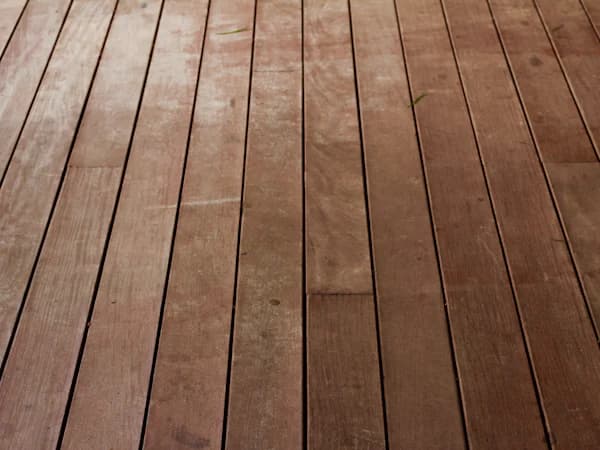
Close-up of natural pressure-treated wood deck boards

Pressure-treated wood

Best for · DIY budget builds
Upfront
$1.85 – $4.10/lf
Lifespan
10 – 15 years
Pros
  • Lowest upfront cost ($15–25/sq ft installed)
  • Universally available — Home Depot, Lowe's, lumberyards
  • Workable with standard fasteners and tools
Cons
  • Annual stain/seal needed (~$0.45/sq ft/yr)
  • Splinters, splits, and warps over time
  • Higher 25-year ownership cost than composite
Try in calculator: PT 2×6 or 5/4×6 deck boards
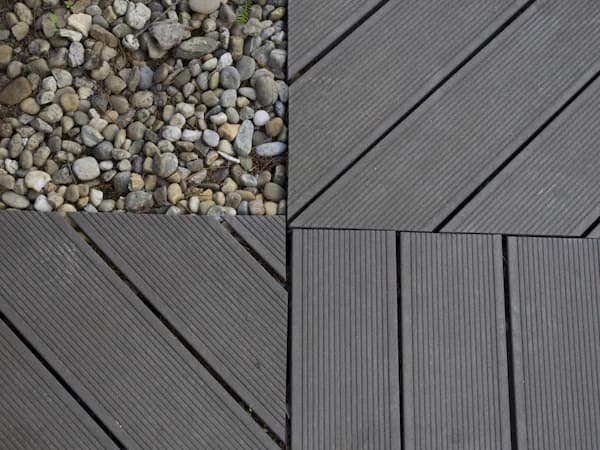
Gray capped composite decking boards

Composite

Best for · Most homeowners
Upfront
$3.20 – $6.40/lf
Lifespan
25 – 30 years (warranty)
Pros
  • Wash-only maintenance ($0.05/sq ft/yr)
  • Capped polymer surface resists stains, mold, fade
  • Lowest 25-year total cost for most builds
Cons
  • Higher upfront ($28–40/sq ft installed)
  • Hidden-fastener systems take 25% longer to install
  • Can run warm in direct sun (lighter colors mitigate)
Try in calculator: Trex Enhance · TimberTech Prime+ · Fiberon Good Life
Modern PVC capped-polymer deck around a home

PVC (capped polymer)

Best for · Pool & coastal decks
Upfront
$4.65 – $7.20/lf
Lifespan
30+ years (lifetime warranty)
Pros
  • Zero rot, zero mold — fully synthetic core
  • Coolest underfoot of the synthetics (mineral-core lines)
  • Best moisture and salt-spray performance
Cons
  • Highest upfront cost
  • Can move slightly more with temperature swings
  • Color palette narrower than composite
Try in calculator: TimberTech AZEK Vintage · Wolf Serenity

How we calculate

How DeckMath calculates this — IRC 2021 sources.

The Composite Deck Cost Calculator is the brand-aware estimator for the homeowner who's already decided on composite or PVC and is now trying to figure out which line — Trex Transcend or Enhance, TimberTech AZEK Vintage or EDGE Prime+, Fiberon Paramount or Good Life, Deckorators Voyage — actually fits the budget. Pick a brand × line × color, set your deck dimensions, pattern, fastener system, and US state, and DeckMath returns a real installed total broken down to the board, the clip, and the linear foot of railing — plus a 25-year total-cost-of-ownership chart that shows when (or whether) composite pays back its premium over pressure-treated wood. Pricing is 2026-Q1 retail (Home Depot, Lowe's, specialty distributors) with state-specific labor multipliers from the RSMeans residential index.

IRC references

  • IRC 2021 R507 — Decks (full)
  • IRC 2021 R312 — Guards (railing required when deck > 30″)
  • IRC 2021 R311.7 — Stairways (rise/run/handrail)
  • AWC DCA-6 — composite deck-board joist spacing limits
  • Trex / TimberTech / Fiberon installation manuals — fastener spacing

Per-LF retail pricing reflects 2026-Q1 manufacturer retail (Home Depot, Lowe's, specialty distributors). Labor multipliers from RSMeans 2026-Q1 residential indices. Manufacturer install specs: Trex / TimberTech / Fiberon / Deckorators published install manuals.

Deck-board linear feet
rows × length × (1 + waste%)

Rows = ceil(width × 12 ÷ (5.5 + 0.125)) — composite face is 5.5″ with 1/8″ install gap. Waste % is pattern-driven: parallel 7%, picture-frame 12%, diagonal 15%, herringbone 20%.

Board count from stock length
ceil(total_lf ÷ longest_stock_length)

Composites stock in 12, 16, and 20 ft. We pick the longest stock to minimize waste. Real installs use a mix; the calculator uses 20 ft as the upper bound and rounds up.

Hidden fastener count
boards × ceil(length × 12 ÷ 16) × 2

Two clips per joist crossing per board, 16″ o.c. joists. Cortex/CamoClip and Trex Universal all spec 2 per joist. A 16×12 deck takes ~520 clips on parallel layout.

Composite labor premium
$35/sqft × 1.25 × pattern_mult × complexity × region

Composite installs are 25% slower than face-screwed PT (compositeLaborMult). Diagonal adds 12%, herringbone 30%. Complexity multiplier covers shape × height × freestanding. Region uses RSMeans 2026-Q1 index.

25-year TCO vs PT
year_n = year_(n−1) + maintenance + (replacement at PT yr 18)

Composite costs project_high upfront + ~$0.05/sqft/yr cleaning. PT costs ~$30/sqft installed + $0.55/sqft/yr stain & seal + a board-replacement around year 18. The break-even year is where the cumulative composite line first dips below cumulative PT.

Contingency reserve
high_estimate × 10%

Industry-standard reserve for unforeseen scope (rotted house framing, hidden utilities, mid-project upgrades). Add to the high estimate, not the low.

Save your plan

Don’t lose this estimate.

Your inputs are preserved in the URL — email it to yourself or copy the link so you can compare with contractor bids later. No account needed.

Get matched

Want 2–3 free quotes for this exact deck?

We'll send your plan to vetted local builders. Free, no obligation.

People also ask

Deck calculator questions, answered.

  • Within ±15% of an actual contractor quote in most US markets. The calculator uses 2026-Q1 national-median pricing from Home Depot, Lowe's, and specialty distributors, with state-specific labor multipliers from RSMeans. Composite is one of the more predictable deck materials to price because the manufacturer publishes per-linear-foot retail prices openly. Variance comes mostly from labor — a Boston deck install runs 1.22× the national average, while suburban Tennessee runs 0.92×. For a permit-ready quote, get 3 contractor bids; this calculator should put you within striking distance of all three.

  • There is no single best — there's a best for your priority. For premium hardwood looks: Trex Transcend or TimberTech AZEK Vintage. For value with brand recognition: Trex Enhance or Fiberon Good Life. For the longest structural warranty: TimberTech AZEK and Wolf Serenity (50 years). For the coolest dark colors in full sun: Deckorators Voyage (mineral-core runs 10-15°F cooler than wood-flour composites) and TimberTech AZEK (PVC reflects more heat than capped composite). For the absolute cheapest brand-name composite: Veranda Armorguard at Home Depot. The calculator lets you A/B any two side-by-side at your dimensions.

  • $50-110 per square foot installed, depending on brand line and pattern. A 16×20 (320 sq ft) Trex Enhance deck with railing and 4 stairs lands around $19,000 nationally; the same deck in Trex Transcend lands around $24,000; in TimberTech AZEK Vintage with a herringbone pattern, $32,000. Materials are roughly 35-45% of installed cost; the rest is labor. Northeast and West Coast markets add another 20-30% on top.

  • Composite decking is 2-3× the per-linear-foot cost of PT (Trex Enhance is ~$3.80/lf vs PT 5/4×6 at ~$1.95/lf), and the install requires hidden-fastener clip systems that take 25-30% longer than face-screwing wood. But composite eliminates ~$0.55/sqft/year in stain and seal, and a typical PT deck needs surface-board replacement around year 18 — composite holds for 25-50 years depending on the line. Run the 25-year TCO chart on this page; for most mid-tier composites, break-even vs PT lands somewhere between year 10 and year 14.

  • Yes, but it's harder than pressure-treated. Hidden-fastener systems are sequential — you can't skip ahead and double-back like you can with face-screws — and grooved boards have less alignment tolerance, so out-of-plane joists will telegraph through the surface. Plan for ~1.5 hr/sqft if you've never done it before; an experienced DIY carpenter can hit 1.0 hr/sqft. Materials savings vs a contractor are typically 50-60% for the install portion. The calculator's brand comparison strip is your shopping list — just add the regional sales tax.

  • Yes. A near-black composite (Trex Lava Rock, AZEK Dark Hickory, Vault Granite) in direct full sun on a 90°F day measures 160-175°F at the surface — hot enough to be uncomfortable barefoot and damaging to the boards over time. Light grays and weathered-look colors stay 30-50°F cooler. Mineral-core composites (Deckorators) and PVC (TimberTech AZEK, Wolf Serenity) run noticeably cooler than wood-flour-core composites at the same color. If full sun is unavoidable, pick a heat-rating-3 color or one of the cooler-running brands.

  • Hidden fasteners (Cortex, CamoClip, Trex Universal Hidden) leave a screw-free surface and are now standard on every grooved composite line. Cost is ~$0.85/sqft, install is ~25% slower than face-screwing. Face-screw plug systems use color-matched plugs over countersunk screws — visible on close inspection but cheaper (~$0.55/sqft). Most homeowners go hidden for the look. Face-screw is fine on un-grooved boards or commercial installs where speed > aesthetics.

  • Composite is wood fiber + plastic — Trex, Fiberon, MoistureShield, Veranda. PVC is 100% polymer — TimberTech AZEK, Wolf Serenity. PVC weighs less, runs ~10°F cooler at the same color, doesn't absorb water at all, and typically carries a longer structural warranty (50 years vs 25-30). Composite is heavier, has more wood-grain authenticity in the cap layer, and is less expensive at the same brand tier. In 2026, the line between top-tier composite and PVC is mostly marketing — both will last 25+ years if installed correctly.

  • The strip shows the same dimensions priced across the 7 most-popular composite lines (Trex Transcend, Trex Enhance, TimberTech AZEK Vintage, TimberTech EDGE Prime+, Fiberon Paramount, Deckorators Voyage, Veranda Armorguard). Tap any to switch the calculator to that line — color resets to the line's first option. It's the fastest way to see what jumping from a value tier to a flagship actually costs on your specific deck.

  • It's a defensible model, not a guarantee. Composite TCO assumes annual cleaning ($0.05/sqft/yr) and no surface replacement. PT TCO assumes biennial stain & seal ($0.55/sqft/yr averaged) and a partial board replacement at year 18 (typical lifespan for budget PT 5/4×6). Real-world variables: a south-facing PT deck in Phoenix may need replacement at year 12; a shaded PT deck in Maine may go 25 years. For composite, a heat-stressed dark-color flagship may show fade by year 10 even though the warranty extends further. Use the chart as a comparison aid, not a contract.

  • Manufacturers segment palettes by line. Trex Transcend gets the full 'tropical hardwood' palette (Spiced Rum, Tiki Torch, Lava Rock), while Enhance Naturals has a pared-down beach-and-grey palette, and Enhance Basics is just Saddle and Clam Shell. The calculator shows whatever palette the manufacturer publishes — when a line discontinues a color, it disappears from the picker. We refresh palettes quarterly.

  • Landscape repair (re-sodding, replacing trampled plants, drainage regrading) — budget $500-2,500 separately. Electrical sub-panel work for integrated lighting if you don't have a 15A 120V circuit nearby. Gas-line relocation if your old deck blocks one. Architectural permits or HOA design-review fees beyond the building permit. Sales tax (varies by state). Contractor mobilization fees on remote sites.

  • In most US jurisdictions, yes — IRC 2021 R105 requires a permit for any deck over 30 inches above grade, attached to the house, or larger than 200 sq ft. Permit fees range from $140 (suburban Midwest) to $320+ (Boston/NYC suburban). The calculator computes permit fee as max(regional baseline, ~1.2% of project value). Some HOAs also require architectural-review committee approval before any deck install — check with your community before signing a contractor.

  • Two reasons. First, board waste: parallel 7%, picture-frame 12%, diagonal 15%, herringbone 20%. A herringbone deck literally needs 13% more material than parallel for the same footprint. Second, labor: parallel = 1.0×, picture-frame 1.18×, diagonal 1.12×, herringbone 1.30×. Pattern-cutting takes longer and pattern-aware joist layouts often need tighter spacing (12″ o.c. vs 16″ o.c.), which adds framing material and labor too.

  • Yes. Use the action bar in the results pane — Save PDF generates a clean printable document, Print uses your browser's print-to-PDF, and Copy Link gives you a shareable URL with all your inputs preserved. Great for getting contractor quotes or sharing with a spouse. The link is short, no login required, valid forever. The PDF includes the materials breakdown, brand comparison, and 25-year TCO summary.

Embed this calculator

One line. Any site. Free.

Drop the snippet into your contractor site, blog, or marketing page. Theme matches the parent site automatically.

<!-- Composite Deck Cost Calculator — free embed by DeckMath -->
<a href="https://deckmath.com/calculators/composite-deck-cost-calculator"
   data-deckmath-calc="composite-deck-cost-calculator"
   data-theme="auto">Free Composite Deck Cost Calculator by DeckMath</a>
<script src="https://embed.deckmath.com/v1.js" async></script>
One tool · free · no signup

Plan the whole project, not just one number

The Deck Project Planner turns your dimensions into a complete material list, cost, 3D preview, and a PDF you can take to the lumber yard — all in one place.