Deck Cost 2026: $25–$140 per Sq Ft Installed, Line by Line
Complete pricing breakdown for residential deck construction in 2026 — materials, labor, permits, regional multipliers, hidden costs, and the math behind every estimate.
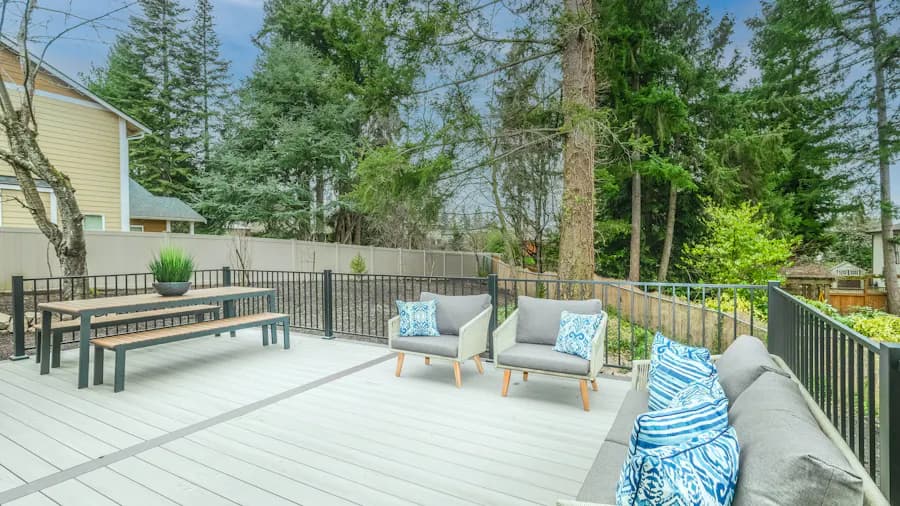
If you're planning a deck in 2026, the single most important number is $/sqft installed — and it ranges wildly. Pressure-treated pine starts at $25-40/sqft, mid-range composite lands at $50-80, premium composite or PVC runs $75-110, and exotic tropical hardwood like Ipe pushes $90-140. On top of that, regional labor swings the number by 30%+ — Northeast and West Coast markets typically run 1.22-1.28× the national average, while the South runs 0.92×. This guide walks through every cost line on a real residential deck, the IRC code drivers behind each, and the math used by DeckMath's calculators (which match RSMeans 2026-Q1 indices and Home Depot/Lowe's retail pricing).
The 5-tier installed pricing ladder
DeckMath uses a 5-tier band system that maps to the actual products you'll see at Home Depot and Lowe's. Each tier shows the installed $/sqft including materials and labor at national averages — the material baseline tracks the BLS Producer Price Index for lumber.
| Tier | Material | $/sqft (installed) | 25-yr maintenance |
|---|---|---|---|
| Budget | Pressure-treated pine 5/4×6 | $25-40 | $0.55/sqft/yr stain |
| Mid | Cedar or premium PT | $35-55 | $0.55/sqft/yr stain |
| Premium | Mid composite (Trex Enhance, Fiberon Good Life) | $50-80 | $0.05/sqft/yr cleaning |
| Luxury | Premium composite (Trex Transcend, AZEK Vintage) | $75-110 | $0.04/sqft/yr cleaning |
| Exotic | Tropical hardwood (Ipe, Cumaru, Garapa) | $90-140 | $0.35/sqft/yr oil |
These are NATIONAL AVERAGES — multiply by 0.92 in the South, 1.22 in the Northeast, 1.28 on the West Coast, and 1.00 in the Midwest. A 16×20 (320 sqft) deck in Texas at premium composite tier lands around $14,700-23,500; the same deck in the SF Bay Area lands at $20,500-32,800.
What's actually in the price
Most homeowners think 'deck cost' = lumber × area. The real breakdown on a typical 16×20 mid-composite build is closer to:
| Line item | % of project | Typical $ on 16×20 mid-comp |
|---|---|---|
| Decking material | 18-22% | $3,200-4,800 |
| Framing (joists, beams, posts, hardware) | 10-14% | $1,800-3,000 |
| Hidden fasteners + screws | 3-5% | $540-1,100 |
| Labor (install) | 45-55% | $8,100-12,100 |
| Railing system | 8-12% | $1,400-2,600 |
| Stairs (4 risers) | 4-6% | $700-1,300 |
| Demo (if existing deck) | 0-7% | $0-1,500 |
| Permit fee | 1-2% | $175-450 |
| Contingency reserve (10%) | 10% | $2,200-4,000 |
Regional labor multipliers
Materials prices are roughly national since lumber and decking ship from regional distribution centers. Labor is the variance driver — regional carpenter wages track the U.S. Bureau of Labor Statistics OES data. RSMeans 2026-Q1 residential indices break the US into 4 regions:
- Northeast (NY, MA, CT, NJ, PA, ME, NH, VT, RI) — 1.22× national
- West (CA, WA, OR, NV, AZ, CO, UT, NM, ID, MT, WY, AK, HI) — 1.28× national
- Midwest (IL, IN, OH, MI, WI, MN, IA, MO, KS, NE, ND, SD) — 1.00× national
- South (TX, FL, GA, NC, SC, TN, KY, AL, MS, AR, LA, VA, WV, OK, MD, DE, DC) — 0.92× national
These multipliers apply to LABOR only. The $/sqft tier price is a blended materials + labor number, so the regional adjustment effectively impacts the labor portion (~50% of total) by the listed factor — overall project cost moves about 15% for a Northeast vs Midwest comparison and ~20% for West vs South.
The hidden costs nobody mentions
These are the line items that show up after you've signed a contract:
Permit fee — $140-450
IRC R105 (ICC) requires a permit for any deck over 30″ off grade, attached to the house, or larger than 200 sqft. Fees scale with project value (~1.2% in most jurisdictions). Boston/NYC/SF suburbs can hit $400+. Skipping the permit costs more later when you sell the house and the buyer's inspector flags an unpermitted addition.
Demolition of existing deck — $4-7/sqft
If you're replacing an existing deck, demo runs $4-7/sqft of the old deck's footprint including haul-away. Asbestos-free assumed; if your deck has lead-painted railings or asbestos-containing waterproofing membranes, add abatement cost ($1,500-3,500).
Landscape repair — $500-2,500
Heavy equipment crossing the yard during framing kills sod, breaks irrigation lines, and tracks dirt through flowerbeds. Most contractors include 'light cleanup' but full landscape restoration is a separate trade. Budget $500-2,500 depending on yard size.
Electrical sub-panel work — $400-1,200
If you're integrating deck lighting and your nearest 15A 120V circuit is more than 50 ft from the deck, you need an electrician to run a new circuit or sub-panel. Required by code for any hardwired exterior fixtures.
HOA architectural-review fees — $50-300
Many HOAs require committee approval before a deck install. The fee is small but the timeline can be 4-12 weeks.
Contractor vs DIY math
Materials are typically 40-50% of installed price. A competent DIYer with weekends free can save 50-60% of total project cost — but realistic effort is the catch. Composite installs run 1.0-1.5 hours per sqft for an experienced carpenter; first-time builders should budget 1.5-2.0 hours/sqft.
| Build type | Contractor estimate | DIY materials only | DIY hours (320 sqft) |
|---|---|---|---|
| Budget PT, ground-level | $8,000-12,800 | $3,400-5,400 | 320-480 hr |
| Mid composite, 36″ height | $16,000-25,600 | $7,200-11,500 | 400-640 hr |
| Luxury composite + Signature rail | $24,000-35,200 | $11,200-16,500 | 480-800 hr |
Financing a deck build
Most homeowners finance decks in one of three ways:
Home-improvement personal loan
Typical 2026 terms: 7.99% APR, 60-month term, no collateral. On a $20,000 deck, that's ~$405/month for 5 years, ~$4,300 in total interest. Rates depend on credit score (740+ gets you the advertised rate; 680-720 adds 2-3%).
HELOC (home equity line of credit)
Typically 1-2% lower than a personal loan since it's secured against home equity. Variable rate — your monthly payment can move with prime. Most banks require 20%+ home equity to qualify.
Credit card
Don't. APRs are 18-24%. A $20,000 deck financed on credit cards over 60 months costs ~$30,000 total. Use cards for $1,000-2,000 in tools and supplies you'll pay off in 3 months, not for the whole project.
How DeckMath calculators work
Every DeckMath cost calculator follows the same formula:
project = (area × $/sqft × shape × height × access) + add-ons + soft costs + contingencyWhere:
- $/sqft is the tier-specific installed price (5 tiers above)
- shape multiplier: rect 1.00, L-shape 1.10, multi-tier 1.20, wraparound 1.25
- height multiplier: ≤24″ 1.00, 24-60″ 1.10, 60-96″ 1.25, >96″ 1.40
- access multiplier: easy 1.00, moderate 1.08, difficult 1.18
- add-ons: railing $/lf × perimeter, stairs $/step × count, lighting $/sqft
- soft costs: permit + demo + design fees (when included)
- contingency: 10% of high estimate
The result is a low-high range that should land within ±15% of contractor bids in most US markets. Run the deck-cost calculator with your dimensions and state — it'll return the exact number with a per-tier comparison strip and a financing card.
What to ask when you get bids
Don't sign with the cheapest contractor. The questions to ask before you commit:
- Who's pulling the permit — you or them? Permit-on-homeowner means you're the contractor of record if something fails inspection.
- Are you using IRC 2021 prescriptive tables or stamped engineering? Most prescriptive PT decks pass without an engineer; non-prescriptive needs a P.E.
- What's the lateral-load anchor solution? IRC R507.9 requires DTT2Z or equivalent at deck-to-house. This is non-negotiable on attached decks.
- Hidden fasteners or face-screws on composite? Hidden are slower and ~$0.30/sqft more — but the surface looks cleaner.
- Pressure-treated lumber dryness — KDAT or green? KDAT (kiln-dried after treatment) costs ~20% more but dries faster and warps less. Most pros prefer it.
- What's the contingency budget? 10% is standard. If the bid says 'no contingency' the bidder will ambush you with change orders.
- What's the post-install warranty? 1 year on labor is the industry standard. Composite manufacturers warrant the boards directly.
- Can I see 3 references from decks you've built in the last 12 months? Ideally same finish tier as yours.
Frequently asked questions
What is the cheapest way to build a deck in 2026?
Pressure-treated pine, ground level, DIY. Each of those words is doing work. Staying under 24 to 30 inches above grade removes the guard requirement, and railing is 8 to 12% of a typical project. Staying under 200 square feet and freestanding can remove the permit in jurisdictions that have adopted the IRC exemption. Doing the install yourself removes the largest line of all, since labor is roughly half the cost of a professionally built deck. That combination lands around $15-25 per square foot in materials plus your time; add stairs and a railing and it moves to $25-35. Two honest caveats for a first-timer: budget $200-400 for tools you do not already own, and count the hours realistically — a 320 square foot budget build runs 320 to 480 hours for someone who knows what they are doing, and roughly double that for someone learning as they go.
How much does a 16x20 deck cost in 2026?
A 16x20 is 320 square feet, and nationally that lands at $9,600-12,800 in budget pressure-treated, $12,800-22,400 in mid-range composite, $19,200-27,200 in luxury composite, and $24,000-32,000 for luxury composite with an aluminum railing, integrated lighting and a under-deck drainage system. Apply your regional multiplier to the labor half of that: about 0.92x in the South, 1.00x in the Midwest, 1.22x in the Northeast and 1.28x on the West Coast, which is a swing of more than 30% between the cheapest and most expensive markets for identical work. Materials are close to national retail wherever you build, so the regional spread is almost entirely labor. If your own bids land more than about 15% either side of those figures, something local is going on — a hot post-storm market, or a bidder padding.
Why is composite decking so much more expensive than wood?
Two reasons, one obvious and one not. The boards cost two to three times as much per linear foot than pressure-treated lumber. Less obviously, composite installs take longer: the hidden-fastener clip systems that give composite its clean surface add 25 to 30% to install time against face-screwing wood, and labor is around half the project. That is the up-front picture. The ownership picture reverses it. Pressure-treated needs stripping and re-staining at roughly $0.55 per square foot per year, while mid-range composite needs about $0.05 in cleaning, and a typical pressure-treated deck starts needing board replacement around year 18 where composite lines are warranted 25 to 50 years. Over a 25-year hold, mid-tier composite usually wins on total cost of ownership. Over three years before a sale, it does not.
Do I need a permit to build a deck?
In most US jurisdictions, yes. IRC 2021 R105 requires a permit for a deck that is more than 30 inches above grade at any point, attached to the house, or larger than 200 square feet — and most decks are at least one of those. Fees range from about $140 in the suburban Midwest to $450 around Boston, New York and San Francisco, which is 1 to 2% of a typical project and the cheapest line on it. What the permit actually buys is an inspector looking at the two details that fail on real decks: the ledger connection to the house and the footing depth. It also changes the schedule rather than just the budget — plan review takes days to weeks, footings must be inspected before concrete is poured, and framing has to pass before decking covers it.
How long does it take to build a deck?
Build time and project time are different numbers, and the gap surprises people. A two or three person crew takes 5 to 10 days on a 320 square foot deck covering framing, decking, railing and stairs. Around that sit the permit review and two inspection holds — footings before the concrete goes in, framing before the decking covers it — so the realistic span from signed contract to walk-through is 8 to 16 weeks. A DIY build of the same scope is 4 to 8 weekends of actual work for someone competent, longer for a first deck, and the inspection holds apply identically. The scheduling lesson is that ordering material early does not speed anything up if the permit has not been issued; get the application in first and let the lumber arrive against a known framing date.
What is a contingency reserve and why is it 10%?
It is a budget line for scope nobody could see when the contract was signed, and on decks it earns its keep more often than not. The classic cases are rot in the house framing revealed when an old ledger comes off, buried utility lines that have to be rerouted around a footing, and mid-project upgrades once the frame is up and the owner can see the space. Ten percent is the industry-standard reserve for residential decks and 15% is more realistic for a full demolition and rebuild, where the condition of what is underneath is genuinely unknown until it is exposed. Budget it as money you expect to spend rather than money you hope to save; the projects that come in on budget are usually the ones that had the reserve and did not need all of it, not the ones that had none.
Can I finance a deck without a HELOC?
Yes, and for most deck-sized projects an unsecured home-improvement loan is the simpler route. Lenders such as Marcus, SoFi, LightStream and Discover fund in one to three days without touching the house as collateral, at roughly 7.99 to 12% APR for borrowers with 740-plus credit. On a $20,000 build that is around $405 a month over 60 months. There is also retailer financing: Home Depot Pro Desk and Trex Pro Platinum both run 0% APR promotions for 12 to 24 months on qualifying projects, which is genuinely cheaper if the balance clears inside the promotional window and expensive if it does not, since deferred interest can be charged retroactively. Read that clause specifically before signing, and check whether the promotion applies to materials only or to the installed job.
Should I get three contractor bids?
Always, and the reason is not to find the lowest number — it is to find out what the job actually is. On a deck that should cost $20,000, three bids typically land somewhere between $15,000 and $25,000, and the spread usually reflects different assumptions rather than different margins: whether demolition is included, whether the railing is composite or aluminum, whether the permit and its fees are the contractor's job. Reading three bids side by side is the fastest way to see what one of them left out. Picking the cheapest is rarely right, because low bidders either cut scope now or bill for it later. The middle bid with the best references is the usual answer, and a higher bid from a Trex Pro Platinum, TimberTech AZEK Pro or Fiberon Pro certified installer can be worth the premium for the labor warranty that comes with it.
Are these prices accurate for my state?
They are national figures with regional multipliers applied to the labor portion, which is where nearly all the geographic variation lives. DeckMath's calculators apply RSMeans 2026-Q1 indices automatically: about 0.92x in the South, 1.00x in the Midwest, 1.22x in the Northeast and 1.28x on the West Coast. Your local quotes should land within about 15% of the projection, because that is the normal bid spread in any market. If bids are coming in 30% or more above it, the likely explanations are a genuinely hot market — post-storm rebuilding, a supply disruption, a region short of deck crews — or a bidder padding heavily, and getting a third quote will tell you which. Permit fees are the one line that is genuinely local and not well predicted by a multiplier, so check yours with the building department directly.
How often do lumber and decking prices move?
Far less than they did. Lumber was extraordinarily volatile from 2020 through 2024 as post-pandemic supply chains reset, with swings large enough to change a project's viability between quote and build. Pricing stabilised through 2025 and 2026, and quarterly drift of 2 to 5% in either direction is now typical. DeckMath's figures are refreshed each quarter, so if you are reading this more than six months after the last-updated date at the top of the guide, expect 5 to 8% of drift on the materials line and none on the structural rules, which do not move with markets. The practical habit worth keeping: get quotes valid for a stated period, and if a project slips a season, re-price the materials rather than assuming the old number still holds.
Related calculators
Related guides
Get matched
Want 2–3 free quotes for this exact deck?
We'll send your plan to vetted local builders. Free, no obligation.