Deck Cost by Size: 10×10 to 20×20 in 2026
The same $/sq ft doesn't apply to every deck. Here's what common deck sizes actually cost in 2026 — and the fixed costs that make small decks pricier per foot.
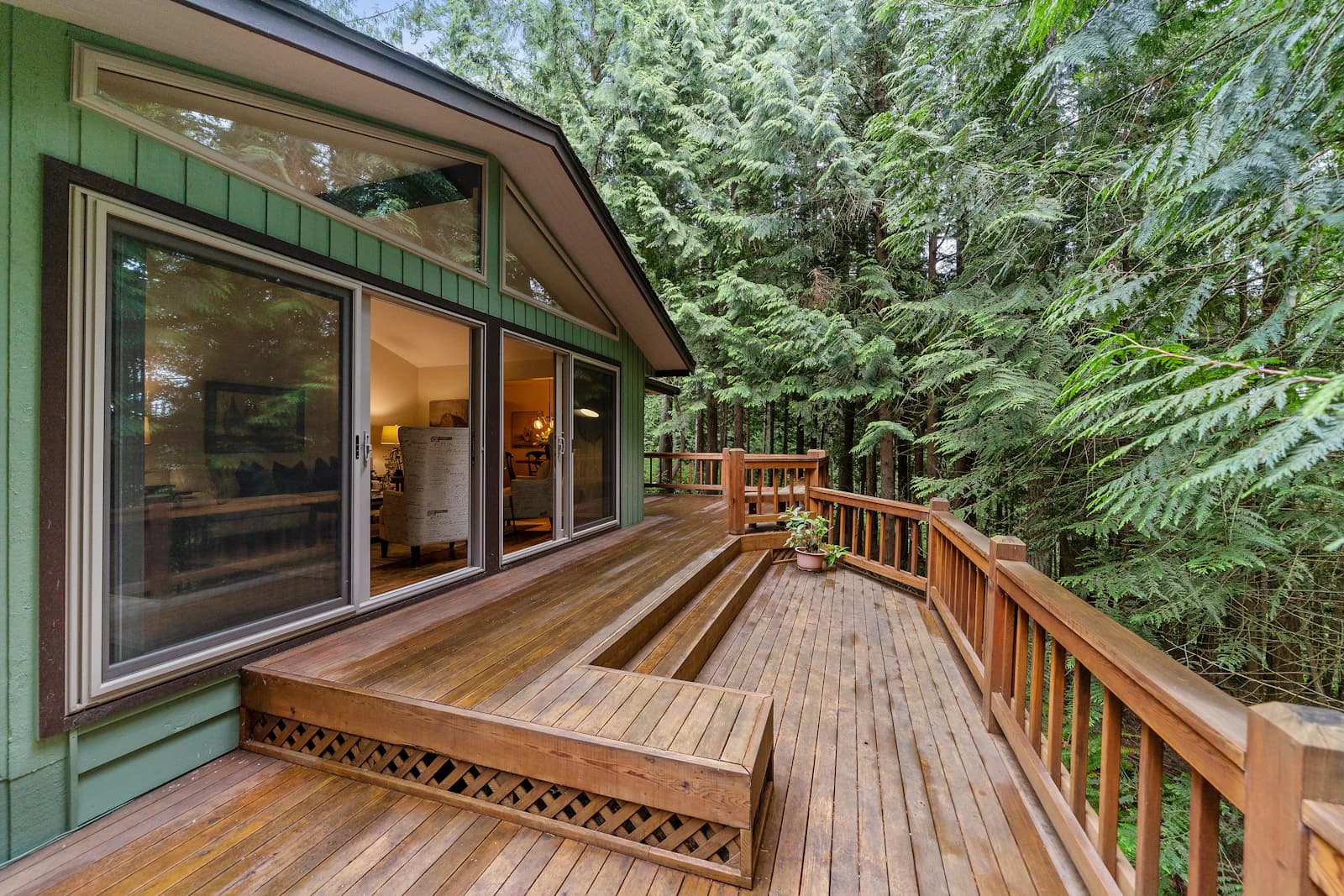
As a 2026 rule of thumb, a mid-range deck runs about $40–$60 per square foot installed — so a 12×12 (144 sq ft) lands near $6,000–$9,000, a 16×20 (320 sq ft) near $13,000–$19,000, and a 20×20 (400 sq ft) near $16,000–$24,000. But cost doesn't scale in a straight line: small decks cost more per square foot because permits, footings, stairs and mobilization are fixed no matter how small the deck is. Here's the full size-by-size breakdown.
Deck cost by size chart (2026)
These are installed-cost ranges spanning budget pressure-treated to mid/upper composite builds at ground-to-standard height. Your real number depends on material, height, railings and local labor — get it exactly with the deck cost calculator.
| Size (ft) | Area | Budget (PT) | Mid (composite) | Premium |
|---|---|---|---|---|
| 10×10 | 100 sq ft | $3,000–$4,500 | $4,500–$6,500 | $6,500–$9,000 |
| 12×12 | 144 sq ft | $4,300–$6,500 | $6,000–$9,000 | $9,000–$12,000 |
| 12×16 | 192 sq ft | $5,800–$8,500 | $8,000–$12,000 | $12,000–$16,000 |
| 16×16 | 256 sq ft | $7,700–$11,500 | $10,500–$16,000 | $16,000–$21,000 |
| 16×20 | 320 sq ft | $9,600–$14,000 | $13,000–$19,000 | $19,000–$26,000 |
| 20×20 | 400 sq ft | $12,000–$18,000 | $16,000–$24,000 | $24,000–$33,000 |

Why small decks cost more per square foot
It surprises people: a 10×10 deck can cost $40–$65 per square foot while a 20×20 drops toward $35–$55. The reason is fixed costs that don't shrink with the deck:
- Permits & inspections cost about the same whether the deck is 100 or 400 sq ft.
- Footings, posts and the ledger are a baseline every deck needs.
- Stairs are a fixed chunk of cost — a small deck still needs a full stair run.
- Mobilization (crew showing up, delivery, setup) is the same trip regardless of size.
Spread those fixed costs over 100 sq ft and the per-foot number is high; spread them over 400 sq ft and it falls. That's why, if you're on the fence between two sizes, going a bit bigger often costs surprisingly little per added square foot. Compare per-foot economics with the cost per square foot calculator.

What changes the number most
- Material. Pressure-treated is cheapest; composite and PVC add $10–$25/sq ft. See cedar vs pressure-treated and PVC vs composite.
- Height. A raised or second-story deck adds taller posts, deeper footings, bracing and code railings — often 30–50% over a ground-level deck of the same size.
- Railings. Basic vs aluminum/cable can swing thousands on the same footprint.
- Stairs & features. Extra stairs, benches, lighting and a pergola each add up.
- Region & labor. Labor is 40–60% of the total and varies widely by market.

How to use these numbers
- Treat the chart as a sanity-check range, not a quote — then get three itemized bids (see how to read a deck quote).
- Pick the size that fits your yard and use, not just a price — an under-sized deck you can't furnish is a false economy.
- Remember the per-foot curve: sizing up one increment is usually cheaper per foot than it looks.

Frequently asked questions
How much does a 12×16 deck cost in 2026?
A 12 by 16 deck covers 192 square feet and lands around $5,800 to $8,500 built in pressure-treated lumber, $8,000 to $12,000 in composite, and $12,000 to $16,000 for a premium build. Those are installed figures covering materials and labour at ground-to-standard height, not material-only numbers. Three things move you within the range faster than the size does. Height comes first, because a raised deck needs taller posts, deeper footings, bracing and code-required railing, which together add 30 to 50 percent over a ground-level deck of the same footprint. Railing choice comes second, since the gap between a basic system and aluminium or cable is thousands of dollars on an identical perimeter. Local labour comes third and is the least visible, because labour is 40 to 60 percent of a deck bill and varies widely between markets. Treat the range as a sanity check, then collect three itemised bids.
How much does a 20×20 deck cost?
A 20 by 20 deck is 400 square feet and runs about $12,000 to $18,000 in pressure-treated, $16,000 to $24,000 in composite, and $24,000 to $33,000 at the premium end installed. It is the largest size on our chart and also the most efficient one on a per-foot basis, typically working out near $35 to $55 per square foot against $40 to $65 for a 10 by 10. The reason is that permits, footings, the ledger, a full stair run and the crew mobilisation cost roughly the same on a small deck as on a large one, so spreading them across 400 square feet dilutes them. At this size two other costs start to matter: the framing itself may need larger or more closely spaced members, and a deck this big often invites features such as lighting, benches or a pergola that push the total well past the decking line item.
Why do small decks cost more per square foot?
Because a large share of a deck bill does not shrink when the deck does. The permit and inspections cost about the same for 100 square feet as for 400. Footings, posts and the ledger are a baseline every attached deck needs regardless of area. Stairs are close to a fixed chunk, since a small deck at the same height still needs a full stair run with the same stringers, treads and landing pad. Mobilisation is the same trip for the crew and the same delivery charge. Spread that fixed block over 100 square feet and the per-foot number climbs toward $40 to $65; spread it over 400 and it falls toward $35 to $55. The practical consequence is worth planning around: the cheapest square feet on any deck are the ones you add to a deck you were already building.
Is it cheaper to build a bigger deck?
Not in total, but usually cheaper per square foot, and that distinction is what should drive the sizing decision. Because permits, footings, stairs and mobilisation stay flat, each additional square foot you add costs closer to the marginal price of boards, joists and labour than to the average price of the whole deck. That is why stepping up one increment, say from 12 by 16 to 16 by 16, often adds less to the bill than homeowners expect from the area increase alone. The argument has limits. Going bigger can push framing members up a size, add footings, and on a raised deck it multiplies the height premium across more area. And a larger deck only pays off if you will use the space. The better question is what you will put on the deck, since an under-sized deck you cannot furnish is a false economy.
What is the average cost per square foot for a deck?
Roughly $30 to $60 per square foot installed in 2026, with a mid-range build clustering around $40 to $60. Where you fall inside that band depends less on size than people assume. Small decks sit toward the high end and large decks toward the low end because of fixed costs, but material is the bigger lever: composite and PVC add about $10 to $25 per square foot over pressure-treated. Height is the next lever, adding 30 to 50 percent for a raised or second-storey build. Railings and features such as extra stairs, lighting, benches or a pergola come after that, and each is a line item that does not track square footage at all. Use a per-foot figure to sanity-check a quote, never to produce one, because two decks of identical area can legitimately differ by a factor of two.
Related calculators
Related guides
Get matched
Want 2–3 free quotes for this exact deck?
We'll send your plan to vetted local builders. Free, no obligation.