DeckMath
Surface · interlocking tile / patio conversion

Deck Tile Calculator

Size interlocking deck tiles for converting concrete patios, balconies, rooftops, or aged wood decks into a fresh wood-look surface. 4 categories compete: IPE wood tiles ($18.50/sqft premium), composite tiles (Trex Outdoor / NewTechWood $10.50), porcelain on Bison Versadjust pedestal ($16.80 + $5.50 install), plastic grid snap (Ikea Runnen $3.40 rental-friendly). Tile count + waste % + substrate prep + edging + adhesive math. Killer feature: 'tile vs new deck rebuild' cost comparison — usually tiles save 30-80% for patio conversions, but IPE tiles can cost MORE than a basic PT deck rebuild.

Start calculating
Get 2–3 free quotes
2026-Q1 retailvs new deck comparison4 tile categories5 substratesCustom-cut waste math
4·Tile categories
5·Substrates
3·Tile sizes
vs deck·Cost compare

Inputs

Area to tile

ft

ft

Area · 120 sq ft
%

5% = straight rectangle. 10% = one cut edge. 15%+ = complex curved or angled area.

IPE wood tile (interlocking) 120 sqft. 136 tiles. Total $3,158.
Deck tiles · IPE wood tile
$3,158$26/sqft installed · 136 tiles
120 sqft12x1213% waste
Tiles needed
120 fit + 16 waste
Tile material
IPE wood tile
Install + prep
prep + labor + edging
$/sqft total
$518 more than new deck

Tile advisories + compatibility

Compatibility OK · IPE wood tile (interlocking) on Concrete patio (ground level)

Manufacturer install spec

Clean + level existing concrete patio. Most popular use case for deck tiles. Light prep only.

Tile count · 136 (120 fit + 16 waste)

Tile spec sheet

13% waste applied (base 8% + 8% custom-cut adjustment). At 1 tiles per sqft on a 120 sqft area.

Costs $518 more than new deck

Cost comparison

Generic PT deck baseline at $22/sqft installed = $2,640. Your tile project = $3,158. Tiles are the premium aesthetic choice — for budget builds consider a regular deck rebuild.

Cost breakdown

Tile material
136 × 12″ × 12″ (1 sqft)
$2,516
Edging trim
44 lf perimeter
$198
Substrate prep
Concrete patio (ground level)
$60
Install labor
120 sqft @ $3.20/sqft
$384
Project total
Compare to a new deck rebuild at ~$22/sqft = $2,640.
$3,158

Rooftop deck instead?

For full rooftop deck design (pedestal + paver + structural load check), open the Roof Deck Calculator instead — it handles the 4-system comparison + building PSF check.

Roof Deck

Visualize your deck

Photoreal 3D · framing · plan. PDF estimate ships with this image embedded.

Loading 3D scene…
12′ × 10
Ipe 5/4×6
Joists
10 × 10′
Beams
2 × 1-ply 2×6
Posts
8 × 4×4
Boards
22 rows

2026-Q1 retail. Tile waste estimates calibrated from contractor surveys. Substrate prep cost based on national-median patio refresh labor. DeckMath is not affiliated with Bison, Trex, NewTechWood, or other brands.

How to use

How to use the deck tile calculator in 7 steps.

  1. 1

    Enter the area to tile

    Length × width in feet. Tiles work best for square / rectangular areas — irregular shapes increase waste from custom cuts.

  2. 2

    Pick a tile category

    IPE wood tile (premium, $18.50/sqft baseline, needs annual oil, 25-yr life). Composite tile (Trex/NewTechWood, $10.50, no maintenance, 20-yr). Porcelain on pedestal (Bison Versadjust, $16.80 + $5.50 install, indestructible, 30-yr, balcony/rooftop premium). Plastic grid snap (Ikea Runnen, $3.40, rental DIY, 8-yr).

  3. 3

    Pick tile size

    12×12 (1 sqft each — small flexibility, more grout lines if porcelain). 20×20 (2.78 sqft — common composite). 24×24 (4 sqft each — porcelain standard, faster install). Larger tiles cover faster but generate more waste in irregular spaces.

  4. 4

    Pick substrate

    Concrete patio (most popular — light prep $0.50/sqft). Concrete balcony (verify dead-load capacity, $1.20/sqft prep). Rooftop membrane (over TPO/EPDM — see Roof Deck Calculator for full pedestal-paver math). Existing wood deck (refresh, $0.30/sqft prep). Compacted gravel (composite only — direct-on-ground installs).

  5. 5

    Set custom-cut percentage

    Out-of-square areas + irregular shapes increase waste. 5% = straight rectangle. 10% = one cut edge. 15% = complex shape with curves. 20%+ = highly irregular (rare). Adds to base tile waste %.

  6. 6

    Optional: glue down + edging

    Glue down (adhesive $1.80/sqft) = permanent install, no movement. Floating install = no glue, just interlocking — better for renters + concrete-balcony with drainage slope. NEVER glue to a rooftop membrane (voids warranty). Edging trim ($4.50/lf) gives a finished perimeter and prevents tile edge damage.

  7. 7

    Read the 'tile vs new deck rebuild' comparison

    Bottom of results shows your total project cost vs the cost of building a new wood deck at the same size. Tiles usually cost 30-80% LESS than a new deck for the same area — because there's no framing + footings + ledger work. But IPE wood tiles can cost MORE than a basic PT deck rebuild. Use this to decide your approach.

Material guide

Wood, composite, or PVC?

Three honest paths. Composite wins the 25-year math for most homeowners, wood wins on upfront cost, and PVC is unbeatable around water. Each card below answers in one glance — recalculate the bill of materials by clicking a brand in the picker above.

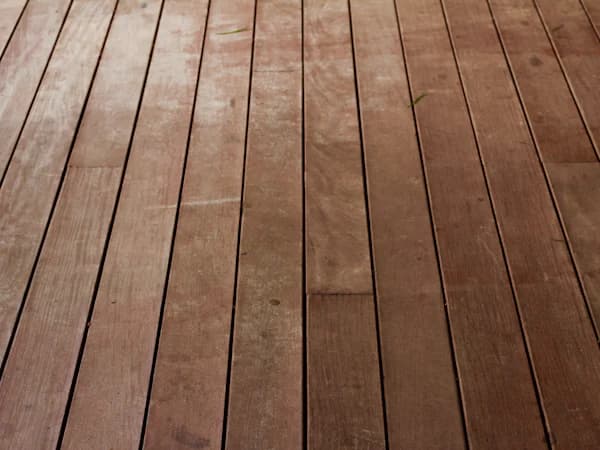
Close-up of natural pressure-treated wood deck boards

Pressure-treated wood

Best for · DIY budget builds
Upfront
$1.85 – $4.10/lf
Lifespan
10 – 15 years
Pros
  • Lowest upfront cost ($15–25/sq ft installed)
  • Universally available — Home Depot, Lowe's, lumberyards
  • Workable with standard fasteners and tools
Cons
  • Annual stain/seal needed (~$0.45/sq ft/yr)
  • Splinters, splits, and warps over time
  • Higher 25-year ownership cost than composite
Try in calculator: PT 2×6 or 5/4×6 deck boards
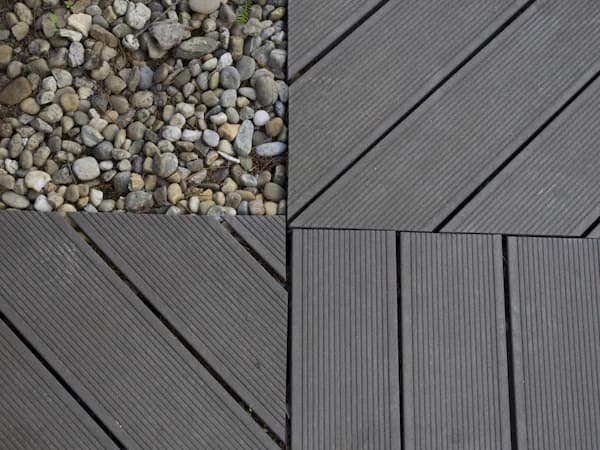
Gray capped composite decking boards

Composite

Best for · Most homeowners
Upfront
$3.20 – $6.40/lf
Lifespan
25 – 30 years (warranty)
Pros
  • Wash-only maintenance ($0.05/sq ft/yr)
  • Capped polymer surface resists stains, mold, fade
  • Lowest 25-year total cost for most builds
Cons
  • Higher upfront ($28–40/sq ft installed)
  • Hidden-fastener systems take 25% longer to install
  • Can run warm in direct sun (lighter colors mitigate)
Try in calculator: Trex Enhance · TimberTech Prime+ · Fiberon Good Life
Modern PVC capped-polymer deck around a home

PVC (capped polymer)

Best for · Pool & coastal decks
Upfront
$4.65 – $7.20/lf
Lifespan
30+ years (lifetime warranty)
Pros
  • Zero rot, zero mold — fully synthetic core
  • Coolest underfoot of the synthetics (mineral-core lines)
  • Best moisture and salt-spray performance
Cons
  • Highest upfront cost
  • Can move slightly more with temperature swings
  • Color palette narrower than composite
Try in calculator: TimberTech AZEK Vintage · Wolf Serenity

How we calculate

How DeckMath calculates this — IRC 2021 sources.

The Deck Tile Calculator sizes interlocking deck tiles for converting an existing concrete patio, balcony, rooftop, or aged wood deck into a fresh wood-look surface. 4 tile categories compete: IPE wood tiles ($12-22/sqft — premium genuine wood), composite plastic-base tiles ($7-14/sqft — Trex Outdoor + NewTechWood), porcelain tiles on Bison pedestals ($14-22/sqft — most premium, indestructible), and plastic grid snap tiles ($2-5/sqft — Ikea Runnen rental-friendly). Plus a 'tile vs new deck rebuild' cost comparison so users can decide if tiles are the right approach for their situation. Tile waste % varies 5-9% based on category + custom-cut percentage. 5 substrate types with prep cost. 2026-Q1 retail.

IRC references

  • Manufacturer install specs: Bison Versadjust (pedestal), Trex Outdoor, NewTechWood
  • IRC R507 deck conversion considerations when tiling existing deck
  • Substrate manufacturer specs for adhesive compatibility

Tile pricing reflects 2026-Q1 national-median retail for IPE wood tiles (multiple suppliers), Trex Outdoor + NewTechWood composite tiles, Bison Versadjust + Eterno IVICA porcelain-on-pedestal systems, Ikea Runnen + generic plastic grid snap tiles. Waste percentages calibrated from contractor surveys. Substrate prep costs based on national-median patio refresh labor rates.

Tile count + waste
tiles = ceil(area × tiles_per_sqft × (1 + waste_pct))

12×12 tile = 1 tile per sqft. 24×24 = 0.25 tiles per sqft. Waste pct = base (5-9%) + custom-cut % × 0.6. Plastic grid tiles have lowest waste (5%); porcelain on pedestal has highest (9%) due to non-cuttable hard tile.

Tile material cost
cost = tiles × area_per_tile × $_per_sqft × size_mult

IPE 12×12 = $18.50/sqft. Composite 12×12 = $10.50/sqft. Porcelain pedestal 24×24 = $16.80/sqft tile + $5.50/sqft pedestal labor. Plastic grid 12×12 = $3.40/sqft.

Substrate prep
prep_cost = area × prep_per_sqft_by_substrate

Concrete patio $0.50/sqft (clean only). Concrete balcony $1.20/sqft (drainage check). Rooftop membrane $1.80/sqft (protection pad). Existing wood deck $0.30/sqft (clean only). Compacted gravel $1.90/sqft (gravel + landscape fabric).

Total project + per-sqft cost
total = tiles + edging + substrate_prep + (adhesive) + install_labor

Most projects: tile material is ~60-70% of total. Edging adds $4.50/lf. Adhesive (if glued) adds $1.80/sqft. Install labor varies $0.80/sqft (plastic grid DIY) to $5.50/sqft (porcelain pedestal premium).

Vs regular deck rebuild
delta = tile_total − (area × $22 baseline_deck)

Generic PT deck baseline = $22/sqft installed. Composite tile project usually saves $4-8/sqft vs new deck because no framing + footings + ledger. IPE wood tiles often cost MORE than a basic PT deck rebuild — they're premium aesthetic, not budget alternatives.

Save your plan

Don’t lose this estimate.

Your inputs are preserved in the URL — email it to yourself or copy the link so you can compare with contractor bids later. No account needed.

Get matched

Want 2–3 free quotes for this exact deck?

We'll send your plan to vetted local builders. Free, no obligation.

People also ask

Deck tile questions, answered.

  • Usually yes for composite tiles ($10-14/sqft vs $22+ for a new deck), tile-on-pedestal porcelain ($18-22/sqft, comparable to new deck), but IPE wood tiles ($22-28/sqft installed) often cost MORE than a basic pressure-treated deck. The savings come from eliminating framing, footings, ledger, and stairs — you're just laying a surface over what's already there. For converting an existing concrete patio to a wood-look surface, tiles are dramatically cheaper than ripping up concrete + building a new deck. For new construction where there's nothing to cover, a regular deck is usually the better deal.

  • Yes for permanent installations where you want real wood underfoot — IPE is the most durable tropical hardwood, naturally rot + insect resistant, with a 25-year lifespan. Tiles on a plastic interlocking base float over the substrate, so they handle thermal expansion + minor unevenness. Annual oil keeps the warm brown color (without oil they fade to silver-gray, which some homeowners prefer). The premium price ($18-22/sqft installed) reflects genuine IPE wood + the engineered base. Best for: high-end residential balconies, urban rooftops, premium patio conversions.

  • Yes — balconies are one of the most popular use cases. Critical checks: (1) The balcony's existing dead-load capacity — pedestal-based porcelain adds 12-15 psf, IPE tiles add 6-8 psf, composite tiles add 4-5 psf, plastic grid tiles add 2-3 psf. Confirm with your building's engineer for multi-family balconies. (2) Drainage slope — balconies must maintain their original water-shedding slope. Floating tile installs preserve this naturally; glued tiles do NOT (glue voids the slope). (3) HOA approval — most condo/apartment HOAs require approval for balcony surface changes.

  • Usually no — most interlocking deck tiles are designed for floating install (no glue, no fasteners). The interlocking base + tile weight holds them in place under foot traffic. Floating install is preferred because: (1) Tiles can be removed for cleaning or substrate access. (2) No damage to the substrate (especially important for concrete balconies + rooftops where adhesive can damage waterproofing). (3) Tiles can be reused if you move. Glue down only when: (a) high foot traffic with concern about shifting, (b) windy locations where tiles can blow around (rare with weight + interlocking), (c) sloped substrate where gravity wants to slide tiles.

  • Substrate must be: (1) Flat — within 1/4″ in 10 feet variation. Bumps and depressions transfer to tile surface; rocking tiles wear out fast. (2) Clean — no loose paint, mildew, or grease that prevents tile contact. (3) Drained — water must shed off in ALL conditions. A puddle that lasts >24 hours after rain = drainage problem that must be fixed before tiling. (4) Structurally sound — no cracking concrete, no rotting wood underneath. For balconies + rooftops, the substrate's structural rating is the gating factor — you can't tile over a balcony that's already maxed out on load.

  • Depends on category. Plastic grid snap tiles (Ikea Runnen, generic Amazon): 5-10 years before UV degradation + brittleness. Composite plastic-base tiles (Trex Outdoor, NewTechWood): 15-25 years with no maintenance. IPE wood tiles: 25+ years with annual oil application. Porcelain on pedestal: 30+ years — porcelain itself is indestructible, pedestal life is ~30 yr UV-stable. Tiles can last longer than the deck framing under them — when you replace your deck in 20 years, the tiles often go on top of the new deck.

  • Most are textured for slip resistance. IPE wood tiles have natural grain providing 0.5-0.6 coefficient of friction wet (above the ADA 0.5 threshold). Composite tiles use textured caps for similar performance. Porcelain tiles range from R10 (basic) to R13 (highly slip-resistant) ratings — choose R11+ for outdoor use. Plastic grid tiles have the lowest slip resistance — when wet they can be slippery especially on slopes. For pool decks + rainy regions, prioritize R11+ porcelain or IPE.

  • Yes for plastic grid snap (15-minute setup time for a 100 sqft patio — literally just snap together) + composite tiles (interlocking, 1-2 hours for 100 sqft). IPE wood tiles take ~2-3 hours for 100 sqft if straight install, longer with cuts. Porcelain on pedestal is the most complex DIY — leveling pedestals to exact height takes practice (rent a laser level + chalk line). Cuts: composite tiles cut with a circular saw or jigsaw. Porcelain requires a wet saw (rentable $50/day). IPE cuts cleanly with a miter saw + carbide blade.

  • On artificial turf: NOT recommended — turf compresses unevenly, causing tile rocking + wear. Remove turf first. On existing pavers: yes if pavers are level + stable. The interlocking tile base bridges small gaps between pavers. Skip if pavers have settled unevenly. Best paver substrate: large-format porcelain pavers (12×12+) that are level + don't shift.

  • Yes, but the slope transfers to the tile surface — you'll feel it walking. Most concrete patios slope away from the house (1/4″ per ft for drainage). At that slope, tiles are walkable + drain water. At slopes over 1″ per ft, tiles become noticeable underfoot and prone to gravity-driven shifting. For chronic-puddling patios that someone tried to 'fix' with poured concrete, tile + Bison pedestals are the solution — pedestals adjust each corner to create a level tile surface above the sloped substrate.

Embed this calculator

One line. Any site. Free.

Drop the snippet into your contractor site, blog, or marketing page. Theme matches the parent site automatically.

<!-- Deck Tile Calculator — free embed by DeckMath -->
<a href="https://deckmath.com/calculators/deck-tile-calculator"
   data-deckmath-calc="deck-tile-calculator"
   data-theme="auto">Free Deck Tile Calculator by DeckMath</a>
<script src="https://embed.deckmath.com/v1.js" async></script>
One tool · free · no signup

Plan the whole project, not just one number

The Deck Project Planner turns your dimensions into a complete material list, cost, 3D preview, and a PDF you can take to the lumber yard — all in one place.