Best Deck Patterns Compared — 2026 Guide
Five common deck board patterns compared on cost, waste, install difficulty, joist-spacing requirements, and visual impact. With real-world dollar deltas on a 16×20 deck.
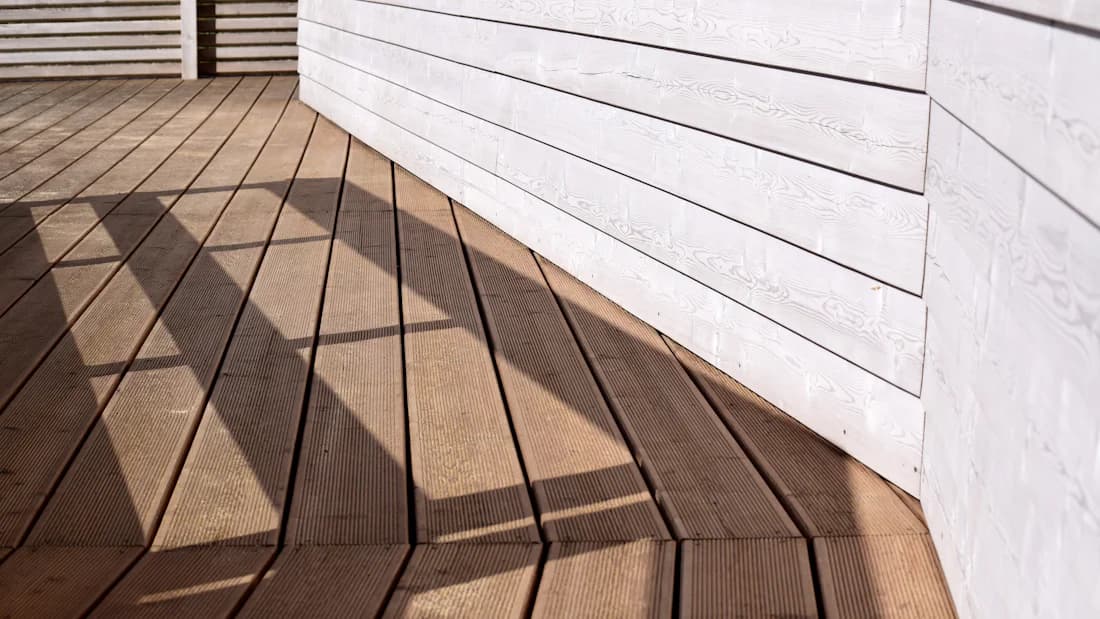
Deck pattern choice is half cosmetic, half budget decision. The cheapest pattern (parallel) and the most expensive (herringbone) can differ by $3,000-5,000 on the same 16×20 deck because of waste rates and labor multipliers. This guide walks through the 5 patterns most homeowners ask for, with real-world cost deltas, joist-spacing implications, and the aesthetic trade-offs.
Pattern 1: Parallel (the default)
Boards run parallel to the long dimension of the deck. Each row is one continuous board (or end-joined to fit the length). The simplest pattern, the lowest waste, the cleanest install.
- Waste %: 7% (factory-trim ends + occasional defect rejection)
- Labor multiplier: 1.00× baseline
- Joist spacing: 16″ o.c. (composite) or 24″ o.c. (PT 5/4×6)
- Aesthetic: clean, traditional, deck looks longer than it is
- Install time: ~1.0 hr/sqft for an experienced carpenter
Cost delta on 16×20 deck (base case): $0 — this is the reference pattern.
Pattern 2: Picture-frame (perimeter band)
Parallel field with a perimeter border that goes around the outside edge of the deck — usually a 2-3 board wide band running perpendicular to the field. Looks like a picture frame around the deck.
- Waste %: 12% (picture-frame border requires precise miter cuts at corners)
- Labor multiplier: 1.18× (extra time for miters + the 'picture frame' edge requires perimeter blocking)
- Joist spacing: 16″ o.c. (composite) — tighter required at perimeter for the band
- Aesthetic: cleaner edge profile, no visible end-grain on cut boards, premium look
- Install time: ~1.2 hr/sqft
Cost delta on 16×20 mid-composite ($16,000 base): +$2,500-3,500. The perimeter band adds 10-15% to total cost — most homeowners think it's worth it for the cleaner look.
Pattern 3: Diagonal 45°
Boards run at 45° to the deck framing. Looks dynamic, makes the deck appear larger, and works well on rectangular decks where you want a non-linear visual.
- Waste %: 15% (diagonal cuts at deck edges generate triangular waste pieces)
- Labor multiplier: 1.12× (more cuts, slightly slower install)
- Joist spacing: MUST be 12″ o.c. (composite) — diagonal boards span longer between joists
- Aesthetic: dynamic, makes deck feel bigger, modern
- Install time: ~1.15 hr/sqft
Cost delta on 16×20 mid-composite: +$3,500-4,500 (combined extra framing + labor + waste).
Pattern 4: Herringbone
Short boards alternated at 90° angles to form a zigzag pattern. Visually intricate, works best on small decks where the pattern can be appreciated up close.
- Waste %: 20% (most cuts, smallest usable board pieces)
- Labor multiplier: 1.30× (slow, precision work — pros bid this pattern at premium)
- Joist spacing: 12″ o.c. + double-blocking under every diagonal seam (often needs custom framing layout)
- Aesthetic: most premium, intricate, shows craftsmanship
- Install time: ~1.4 hr/sqft
Cost delta on 16×20 mid-composite: +$5,500-7,500 — the most expensive standard pattern. Best for small deck areas (~150 sqft) where the pattern is fully visible. Skip on large decks where the visual benefit is diluted.
Pattern 5: Chevron / V-pattern
Like herringbone but with miter cuts at 45° rather than 90° butt joints — creates continuous V-pattern lines across the deck. Slightly faster install than herringbone but harder to source matched boards.
- Waste %: 18% (45° miter cuts generate triangular waste)
- Labor multiplier: 1.28× (similar to herringbone)
- Joist spacing: 12″ o.c. + similar custom blocking
- Aesthetic: more modern than herringbone, clean V-lines
- Install time: ~1.35 hr/sqft
Cost delta on 16×20 mid-composite: +$5,000-7,000. Comparable to herringbone but easier on the eye if you want the look without the full visual intricacy.
Pattern cost summary
| Pattern | Waste % | Labor mult | Joist spacing | Cost delta on 16×20 |
|---|---|---|---|---|
| Parallel | 7% | 1.00× | 16″ o.c. | Base |
| Picture-frame | 12% | 1.18× | 16″ o.c. | +$2,500-3,500 |
| Diagonal 45° | 15% | 1.12× | 12″ o.c. | +$3,500-4,500 |
| Herringbone | 20% | 1.30× | 12″ o.c. + blocking | +$5,500-7,500 |
| Chevron / V | 18% | 1.28× | 12″ o.c. + blocking | +$5,000-7,000 |
Pattern + decking material interaction
Pattern choice changes by decking material:
Pressure-treated 5/4×6
Most flexible — can do parallel, picture-frame, diagonal at 16″ o.c. (PT 5/4×6 spans 16" diagonal). Herringbone + chevron need 12″ o.c. for stiffness.
Composite (Trex, TimberTech, Fiberon)
Manufacturer specs (Fiberon, typical of all major brands): parallel 16″ o.c., diagonal/herringbone/chevron 12″ o.c. The 12″ requirement adds framing cost regardless of pattern aesthetic.
Tropical hardwood (Ipe)
Predrilling required for any pattern. Diagonal + herringbone are common on Ipe builds because the dense wood holds tight cuts beautifully — but install time doubles vs pressure-treated.
Cedar
Standard wood spacing rules apply. Cedar accepts all 5 patterns equally. Pattern cost premiums match pressure-treated.
When to upgrade pattern
Pattern upgrade is worth it when:
- Small deck (under 200 sqft) — the pattern is visible up close
- Highly visible deck — front-of-house deck or main entertaining surface
- Premium aesthetic budget — you've already gone composite or PVC
- Distinctive design intent — you want the deck to look custom
Pattern upgrade is NOT worth it when:
- Big deck (400+ sqft) — pattern visual benefit is diluted
- Tight budget — the $3,000-7,000 premium can be reallocated to a better railing system or composite tier upgrade
- DIY install — first-time builders should stick to parallel, layout errors compound on diagonal/herringbone
- Hot-sun deck — pattern doesn't help with heat; spend the money on a heat-mitigation cap (Trex Lineage) instead
Frequently asked questions
What's the best deck pattern?
There is no single winner, because the right pattern is set by deck size, visibility and budget rather than by taste alone. Parallel is the correct default: 7 percent waste, no labour multiplier, 16 inch joist spacing for composite, and it makes a deck read longer than it is. Picture-frame is the best value upgrade, adding a perimeter band that hides cut end-grain for roughly $2,500 to $3,500 on a 16 by 20 deck. Diagonal at 45 degrees makes a rectangular deck feel larger, but it forces 12 inch joist spacing on composite, which is why it lands at $3,500 to $4,500 over parallel. Herringbone and chevron are the showpieces at $5,500 to $7,500 and $5,000 to $7,000 respectively, and both want 12 inch spacing plus blocking. The rule that holds across all of them: the smaller and more visible the deck, the more a pattern earns its premium.
How much does diagonal decking cost?
On a 16 by 20 mid-composite deck, expect $3,500 to $4,500 more than the same deck laid parallel, which is a premium of roughly 20 to 25 percent over the base. That number comes from three separate additions rather than one. Waste rises from 7 percent to 15 percent, because cutting boards to the deck edge at 45 degrees leaves triangular offcuts that cannot be reused. Surface labour rises by about 12 percent, since every board needs two angled cuts and the install runs closer to 1.15 hours per square foot. The largest and least visible component is framing: composite manufacturers require 12 inch joist spacing for diagonal layouts instead of 16, which adds roughly 30 percent to framing cost in joists, hangers and labour. That framing line is the part homeowners miss when they compare a diagonal quote against a parallel one.
Why does diagonal need 12-inch joist spacing?
Because a board laid at an angle spans further between supports than one laid square to the joists. Run boards perpendicular and each one crosses joists at the spacing you framed, say 16 inches. Turn those boards 45 degrees and the distance along the board between the same two joists grows by roughly 41 percent, so the unsupported span the board has to carry grows with it. Composite boards are stiff enough for a 16 inch perpendicular span but not for the longer diagonal equivalent, which is why manufacturer installation manuals require 12 inch on centre for diagonal layouts. Pressure-treated 5/4 by 6 is an exception and can generally handle diagonal at 16 inch, while herringbone and chevron want 12 inch in any material for stiffness at the seams. Ignore the requirement and you get bounce between joists and a warranty claim the manufacturer can decline.
What's the difference between herringbone and chevron?
The joint. Herringbone alternates short boards at 90 degrees so each board butts into the side of the next, producing a broken zigzag with a traditional, parquet-like feel. Chevron mitres the ends at 45 degrees so boards meet point to point, producing continuous unbroken V lines across the deck, which reads as more modern. The economics are close but not identical: herringbone carries about 20 percent waste and a 1.30 labour multiplier, chevron about 18 percent waste and 1.28, landing at roughly $5,500 to $7,500 and $5,000 to $7,000 over parallel on a 16 by 20 composite deck. Both need 12 inch joist spacing with additional blocking under the seams, and both are precision work that contractors bid at a premium. Chevron is slightly faster to install but harder to source well-matched boards for, since mitred joints show colour variation more.
Does pattern affect waste %?
Substantially, and it is the part of a pattern premium that homeowners can control by ordering correctly. Parallel runs about 7 percent waste, which is essentially factory trim ends and the occasional rejected board. Picture-frame rises to 12 percent because the perimeter band needs precise mitres at every corner and a bad cut wastes a full board length. Diagonal reaches 15 percent, herringbone 20 percent, and chevron 18 percent, all for the same underlying reason: angled cuts produce triangular offcuts and short ends that no other course can use. The practical instruction is to order to the pattern rather than to the area. Buying parallel-sized quantities for a herringbone deck guarantees a second delivery, and on composite a re-order weeks later risks a different production batch with a visible colour shift.
Can I mix patterns on the same deck?
Yes, and the most common mix is also the most successful one: a parallel field with a picture-frame border. That combination gives you the clean perimeter edge and hidden end-grain of the premium look while keeping the field at parallel waste and labour rates, which is why it is the best value upgrade on the pattern ladder. Mixing a diagonal or herringbone zone into a parallel deck also works visually, typically to mark a dining area or a landing, but it needs extra blocking under the transition seam so both fields land on solid support, and the framing layout has to be planned for it before joists go in rather than adapted afterwards. Set the design before framing, not during decking. A transition added late usually means adding blocking from underneath, which on a low deck can be genuinely awkward work.
Is herringbone worth the cost?
On a small deck, often yes. Under about 200 square feet the pattern is fully visible from anywhere on the deck and from the house, so the craftsmanship you paid for is what people see, and at that size the premium is a smaller absolute number. On a large deck the case collapses. Past roughly 400 square feet the eye stops reading the zigzag as a pattern and the same $5,500 to $7,500 buys more visible improvement elsewhere, whether that is a better railing system, a composite tier upgrade or lighting. Two other disqualifiers are worth stating plainly. If you are installing it yourself for the first time, choose parallel, because layout errors compound in herringbone in a way they do not in a straight run. And if heat is your complaint, pattern does nothing at all; a heat-mitigating board colour does.
How does the pattern affect maintenance?
On wood it matters, on composite it does not. Angled patterns create far more cut edges, and every cut on pressure-treated lumber exposes untreated end-grain that wicks water straight into the board. Diagonal, herringbone and chevron therefore need end-cut preservative applied to each cut before the board goes down, and those end-grain points remain the first places to show rot or checking if resealing slips. Cedar behaves similarly, with softer fibres at the cut. Composite and PVC are unaffected because the cap covers the visible surfaces and the core does not absorb water the way timber does, so a herringbone composite deck washes exactly like a parallel one. If you want an intricate pattern and minimal upkeep, that difference is a real argument for choosing composite as the material rather than paying twice, once for the pattern and again for the maintenance it creates.
What pattern works best on a small deck?
Picture-frame, in most cases. On a deck under about 200 square feet the perimeter is a large share of what you actually see, so banding it with a two or three board wide border transforms the look, hides every cut end-grain, and reads as custom work, all without touching joist spacing. It costs a 1.18 labour multiplier and 12 percent waste rather than the 12 inch framing rebuild that diagonal and herringbone demand. If you want more drama and the deck is genuinely small and close to the house, herringbone earns its keep here better than anywhere else, because the intricacy is visible at the distance people stand. What to avoid on a small deck is a pattern that fights the proportions: strong diagonals can make a compact deck feel busy, whereas parallel boards run the long way make it read longer than it is.
Are pattern multipliers built into DeckMath calculators?
Yes. The deck cost calculator, the deck material calculator, the composite deck cost calculator and the Trex deck calculator all apply the same pattern-specific waste percentages and labour multipliers used in this guide, so switching pattern in the inputs moves both the board count and the bottom line rather than just the label. That matters because the three cost effects of a pattern arrive in different line items: waste changes the material quantity, the labour multiplier changes the install cost, and the 12 inch joist requirement on diagonal, herringbone and chevron changes the framing. Pricing a pattern by adding a rough percentage to a parallel quote misses the framing component entirely, which is the single most common way homeowners underestimate a diagonal deck. Run the same dimensions twice, once per pattern, and compare the totals directly.
Related calculators
Related guides
Get matched
Want 2–3 free quotes for this exact deck?
We'll send your plan to vetted local builders. Free, no obligation.