Your tropical hardwood,
costed.
Exotic tropical hardwood cost engine — 5 South American species (IPE, Cumaru, Tigerwood, Garapa, Massaranduba), grade, board size, optional FSC, and yearly Penofin oil. Real installed cost + 40-yr TCO + premium composite benchmark. Stainless 305 fasteners + pre-drilling mandatory.
- No signup
- IRC 2021 verified
- 120+ calculators
- Free forever
Adjust size, material tier, state and scope below — the estimate and the 3D deck repaint instantly.
Inputs
Deck dimensions
Scope + sustainability
Results
IPE · SELECT · 5/4x6 · PA (Northeast, 1.22× labor)
Guardrail included — required at 36″ height (>30″)
IRC R312.1IRC R312.1.1 mandates 36″ minimum guardrail above 30″ walking surface. R312.1.3.1 — balusters spaced so 4″ sphere cannot pass.
IPE (Ipê / Brazilian Walnut) · Janka 3680
IRC R317.3 (naturally durable woods)Deep olive-brown with subtle dark streaking. Silvers to soft pewter-gray within 18-24 months untreated. 50-yr expected lifespan. Source: Brazil · Bolivia · Paraguay.
Pre-drilling MANDATORY at every fastener (Janka 3680)
Hardwood install best practiceStandard composite/PT screws will split boards + break bits. Process: countersunk pilot hole (carbide bit) + clearance hole + stainless 305 screw. ~90 sec per fastener vs 30 sec for composite. Built into labor rate $22-38/sqft.
Stainless 305 fasteners REQUIRED — tannin reaction with galv
ASTM A276 stainless · Hardwood tannin chemistryHardwood tannins react with hot-dipped galvanized steel — black streaks down the boards within 6-12 months. Use SS 305 (standard) or SS 316 (marine, within 5 mi of saltwater). NEVER HDG. Joist hangers below: Simpson HDG SS or stainless equivalent.
Yearly oil maintenance — 40 years
Yearly oil application keeps the deep olive-brown with subtle dark streaking. Skip the oil and boards silver to soft pewter-gray within 18-24 months — aesthetic only, no structural impact. Many IPE owners deliberately skip oil for the patina. Pro re-finish (clean + sand + oil) ~$3/sqft if you want to restore color years later.
vs premium composite — 40-yr head-to-head
IPE costs $16,244 more than premium composite over 40 years. The hardwood premium pays back beyond year 35+, when composite would need replacement. For 40+ year ownership, hardwood wins TCO decisively.
| Cost component | Share | Amount |
|---|---|---|
| Materials | 53% | $10,620 |
| Labor | 39% | $7,870 |
| Contingency (8%) | 7% | $1,479 |
| Total (high est.) | 100% | $19,969 |
High-estimate install split — materials (boards + stainless + framing + railing/stairs), labor (pre-drill premium), 8% contingency.
Cost breakdown
- Materials (boards + stainless fasteners + framing + railing + stairs)
- $9,770 – $10,620
- Labor (Northeast 1.22× · pre-drill premium)
- $6,184 – $7,870
- Subtotal
- $15,954 – $18,490
- Contingency (8%)
- $1,479
- Initial install total
- $15,954 – $19,969
- Yearly oil maintenance (40 yr)
- $7,296
- 40-year TCO total
- $27,265
2026-Q1 retail at specialty hardwood distributors (Advantage Lumber, Mataverde, Edensaw, Iron Woods). Materials BoM includes IPE 5/4x6 SELECT boards, stainless 305 fasteners + carbide pre-drill bits, PT pressure-treated substructure, matching hardwood railing (if scoped), stair treads (if scoped). Labor $22-38/sqft × Northeast regional multiplier (1.22×) — premium rate reflects pre-drilling. Excludes permit, design fees, demolition.
Visualize your deck
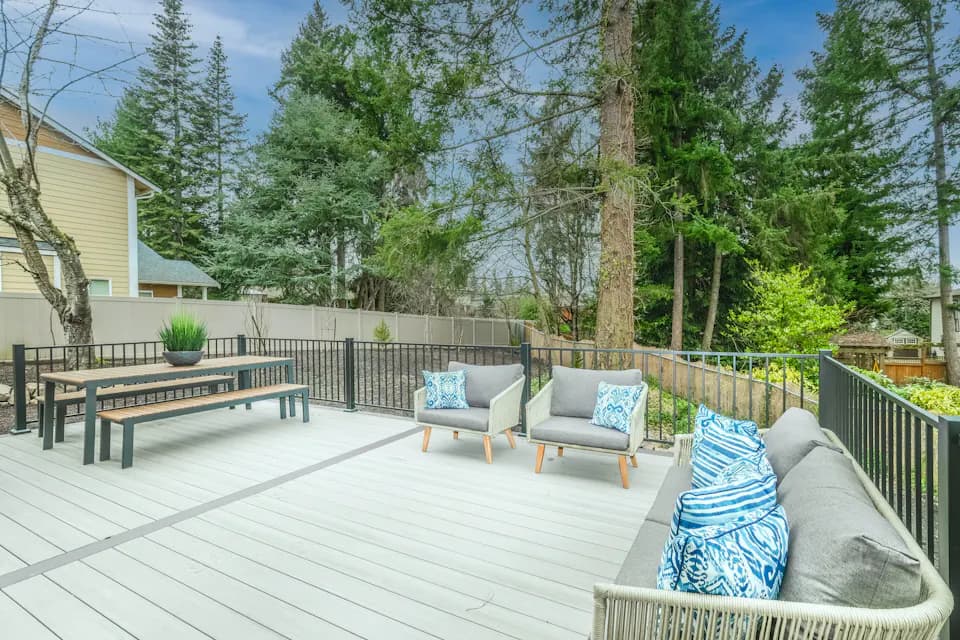
Photoreal 3D · framing · plan. PDF estimate ships with this image embedded.
Get matched
Want 2–3 free quotes for this exact deck?
We'll send your plan to vetted local builders. Free, no obligation.
How to use
How to use the deck calculator in 5 steps.
- 1
Enter deck size + height
Length × width in feet (longer side first). Shape: rectangle or L-shape (L-shape applies 0.85 area factor + 1.10 perimeter premium). Deck height drives railing trigger (>30″ → IRC R312.1 36″ guardrail). Hardwood substructure typically uses 2×10 PT joists @ 16″ o.c. (heavier joists than PT-board decks) due to 3.5× board load.
- 2
Pick a species
IPE ($9.50/lf, Janka 3680, 50-yr life, olive-brown) is the benchmark. Cumaru ($7.95, Janka 3540, 45-yr, golden-brown) is the best-value alternative at ~15% less. Tigerwood ($6.95, Janka 2160, 35-yr) has dramatic tiger-stripe grain. Garapa ($5.95, Janka 1700, 30-yr) is the cheapest hardwood with pale-gold color. Massaranduba ($7.50, Janka 3190, 40-yr) is the red 'Brazilian Redwood'.
- 3
Pick grade + board size + FSC
Grade: FAS (First & Seconds — clearest, +20%) / Select (most-stocked retail grade, baseline) / Standard (more defects, −15%). Board size: 1×4 narrow ($/lf cheaper but more LF needed), 5/4×4, 5/4×6 standard reference. FSC certification toggle adds 13% premium for sustainable sourcing (limited supply for IPE; better availability for Cumaru/Garapa).
- 4
Maintenance toggle
Yearly Penofin Hardwood Oil ($0.95/sqft material) preserves the original color. Without it, all hardwoods silver to soft gray within 18-24 months (slower than cedar). The silvered look is aesthetic-only — no structural impact. Many IPE owners prefer the silvered patina. To restore color later: full clean + light sand + re-oil (~$3/sqft pro job, or DIY weekend).
- 5
Read TCO + composite benchmark
Headline: initial install $/sqft + project total + 40-yr TCO. Benchmark against premium composite (Trex Transcend equivalent at $55/sqft installed + $0.06/sqft/yr maintenance + 30-yr life). Hardwoods typically beat composite TCO at year 30+ (when composite needs replacement). For short ownership (<15 yrs), composite wins on TCO; hardwoods win on aesthetics regardless of horizon.
How we calculate
How DeckMath calculates this — IRC 2021 sources.
The IPE Hardwood Deck Cost Calculator is the tropical-hardwood deep-dive — pick from 5 South American hardwoods (IPE / Brazilian Walnut, Cumaru / Brazilian Teak, Tigerwood / Goncalo Alves, Garapa / Brazilian Ash, Massaranduba / Brazilian Redwood), grade (FAS / Select / Standard), board size (1×4 narrow, 5/4×4, 5/4×6 standard), FSC certification toggle, and optional yearly Penofin Hardwood Oil for color retention. Returns real installed cost + 40-yr TCO + premium composite benchmark. Built on 2026-Q1 retail at specialty hardwood distributors (Advantage Lumber, Mataverde, Edensaw). Pre-drilling stainless 305 fasteners mandatory — Janka 1700-3680. Pairs with Cedar Deck Calculator (cedar) and PT Deck Cost Calculator (budget option).
IRC references
- IRC 2021 R317.3 — Naturally durable woods (tropical hardwoods qualify above-grade)
- IRC 2021 R317.1 — Ground-contact lumber required <6″ of grade (PT for joists, NOT hardwood)
- IRC 2021 R507.6 — Joist span tables (apply to PT substructure; hardwood boards on top)
- IRC 2021 R312.1.2 — Guardrail 36″ min height
- ASTM D2244 — Color stability standard (hardwoods exceed plastic deck-board ASTM D7032 fade requirements)
- FSC-STD-40-004 — Chain-of-custody for forest certification (FSC label assurance)
Verify against the published source: 2021 International Residential Code (ICC).
2026-Q1 retail at specialty hardwood distributors (Advantage Lumber, Mataverde, Edensaw Woods, Iron Woods). Base $/lf (5/4×6 Select, non-FSC): IPE $9.50, Cumaru $7.95, Tigerwood $6.95, Garapa $5.95, Massaranduba $7.50. Grade: FAS 1.20× / Select 1.00× / Standard 0.85×. Board size: 5/4×6 1.00× / 5/4×4 0.75× / 1×4 0.55×. FSC certification: +13%. Stainless 305 fasteners + carbide pre-drill bits $2.20/sqft. PT substructure $7.50/sqft. Matching hardwood railing $75/lf. Stairs $325/step. Labor $22-38/sqft × regional multiplier (premium rate due to pre-drilling — ~50% over composite). Penofin Hardwood Oil maintenance $0.95/sqft/yr (optional).
Board cost = (area / boardFace) × 12% waste × baseLineRate × grade × board-size × (FSC? × 1.13 : 1). Stainless 305 fasteners + carbide bits $2.20/sqft (mandatory — tannin reaction with galv + pre-drill required). PT substructure $7.50/sqft. Matching hardwood railing $75/lf. Hardwood stair treads $325/step. Labor $22-38/sqft × regional multiplier (premium rate due to pre-drilling — adds ~50% to install time vs PT).
Penofin Hardwood Oil (or Messmer's UV Plus, Cabot Australian Timber Oil for hardwoods) — yearly application. ~$0.95/sqft material DIY (1 gallon covers ~250 sqft, 2 coats). Total maintenance for 200 sqft deck over 40 years = ~$7,600 if maintained on schedule. Skip maintenance: silvering happens within 18-24 months, no other consequence.
Premium composite benchmark uses Trex Transcend / TimberTech LEGACY installed cost ($55/sqft) + $0.06/sqft/yr cleaning maintenance. 30-yr expected life. Hardwoods typically MORE expensive than composite on install (~$50-70/sqft for hardwood vs $55 composite) but BEAT composite TCO at year 30+ because hardwoods last 35-50 yrs vs composite 25-30. Crossover year depends on species + maintenance.
Base prices (5/4×6 Select, non-FSC): IPE $9.50, Cumaru $7.95, Tigerwood $6.95, Garapa $5.95, Massaranduba $7.50. Grade mult: FAS 1.20 / Select 1.00 / Standard 0.85. Size mult: 5/4×6 1.00 / 5/4×4 0.75 / 1×4 0.55 (smaller boards cheaper per LF but need more total LF — area / face × waste). FSC adds 13% across the board.
All tropical hardwoods (Janka >1500) require pre-drilling at every fastener point. Process: countersunk pilot hole + clearance hole + fastener. Skipping = split boards + bit failure + stripped screws. Built into the $22-38/sqft labor rate. DIY: budget 3× standard PT install time. Tools needed: carbide-tipped drill bits (replace every 200-300 fasteners), countersink bit, stainless 305 trim-head screws (matched to species color).
Save your plan
Don’t lose this estimate.
Your inputs are preserved in the URL — email it to yourself or copy the link so you can compare with contractor bids later. No account needed.
People also ask
Deck calculator questions, answered.
$45-95/sqft installed, all-in. The variance is driven by species (Garapa $45/sqft on the low end / IPE Premium-Select on the high end at $95), grade (FAS +20%), board size (5/4×6 baseline, narrow 1×4 ~15% less material cost but more labor), FSC (+13%), railing inclusion ($75/lf hardwood-matched), and regional labor (Northeast 1.22× / West 1.28× / South 0.92× / Midwest 1.00×). A 16×12 (192 sqft) IPE Select 5/4×6 non-FSC deck with hardwood railing + 4 stairs in PA runs ~$13,000-17,500 installed. Most expensive deck material category — but unmatched longevity.
Yes for: (1) Lifetime ownership (40+ years) — IPE outlasts composite (25-30 yrs); composite needs replacement at year 30, IPE doesn't. (2) Authentic wood look — composite mimics wood; IPE IS wood, with grain depth that doesn't repeat across boards. (3) Cooler underfoot — IPE +6°F over PT baseline vs premium composite +15°F. (4) Janka 3680 hardness — virtually scratch-proof from chairs/pets/dropped tools. No for: tight budget, DIY (pre-drilling every fastener is tedious), no maintenance time (silvering happens regardless), or sustainability priority (sourcing concerns even for FSC IPE).
50+ years with proper installation. Field-verified IPE installs from the early 1990s (Atlantic City Boardwalk reconstruction, NYC Hudson River Park) are still in excellent structural condition after 30+ years. IPE's natural decay resistance (AWPA Class 1 — same as PT chemical treatment) + extreme density (specific gravity 0.92) + tannin content makes it inherently rot- and insect-proof. Cumaru and Massaranduba ~45 years. Tigerwood 35 years. Garapa 30 years. Lifespan is functionally limited by substructure (PT joists, ~25-30 yrs) — you'll likely replace framing before the IPE boards.
Both Brazilian tropical hardwoods with similar performance, ~15-20% price gap. IPE: Janka 3680 (slightly harder), olive-brown to dark chocolate color, 50-yr lifespan, $9.50/lf 5/4×6 Select retail. Cumaru: Janka 3540 (~96% as hard), golden-brown to reddish-brown, 45-yr lifespan, $7.95/lf (~17% cheaper). Cumaru has more grain variation board-to-board than IPE's relatively uniform color. Cumaru oxidizes faster (silver within 12-18 months vs IPE 18-24). For Brazilian-hardwood look at lower budget: Cumaru wins. For matching color across large decks: IPE. Both require the same installation (pre-drill, stainless 305).
Surprisingly cool for a dark wood — +6°F over PT baseline on sunny 90°F day. IPE's extreme density (95+ lb/cu-ft, ~25% denser than oak) means high thermal mass — it heats up slowly AND cools down slowly. At noon: IPE ~106°F, premium composite ~110°F, AZEK PVC ~99°F, PT ~100°F. Compared to dark composite (Trex Transcend Spiced Rum ~115°F), IPE runs significantly cooler. The trade-off: IPE retains evening heat longer (sun-up to sunset), while PVC cools faster after sun moves off. For sustained barefoot midday use, IPE outperforms most composites.
Janka 3680 — that's 3-4× harder than PT (Janka 1000), 8× harder than cedar (Janka 350). Standard composite/PT screws require ~30 sec per install (drive directly into board). IPE requires: (1) countersunk pilot hole (~6mm diameter to depth of screw head) using carbide bit, (2) clearance hole (~smaller diameter for shaft) at proper depth, (3) drive stainless screw. ~90 seconds per fastener. Skipping pre-drill: 80%+ chance of board splitting at fastener point, broken bit, or stripped screw. Use carbide-tipped drill bits (replace every 200-300 holes). Some pros use a Camo Edge clip system to face-mount without visible screws — works on IPE but still requires pre-drilling.
Stainless steel 305-grade (305 is standard; 316 marine-grade required within 5 miles of saltwater). NEVER use hot-dipped galvanized — IPE's tannin acids react with zinc, causing black streaks down the board within 6-12 months. Recommended specs: #8 × 2.5″ stainless trim-head screws (Headcote Stainless or Starborn Pro Plug) for face-mount face-screw installs. Hidden fasteners: Tiger Claw HF-IPE (carbide-rated) or Camo Edge clip + Camo screws. Pre-drilling bits: 5/32″ pilot hole + countersink, replaced after every 200-300 holes (carbide tipped only). Stainless joist hangers: Simpson HDG SS for the PT joists below. Budget $2-3 per sqft for stainless fastener + bit costs vs $0.95 for composite.
Optional — depends on whether you want to keep the original color or accept silvering. With yearly oil (Penofin Hardwood, Messmer's UV Plus, or Cabot Australian Timber Oil): wood retains original color (deep brown for IPE, golden for Cumaru, etc) for the life of the deck. ~$0.95/sqft material + 1 weekend per year DIY. Without oil: silvering happens within 18-24 months — soft pewter-gray patina that doesn't affect structural integrity. Many IPE owners prefer the silvered look — it's classic and low-maintenance. Some compromise: oil every 2 years (slows silvering, less work). Decision is purely aesthetic.
FSC IPE exists but is genuinely scarce. Sustainable IPE harvesting requires careful management — trees take 60-100 years to mature. Most IPE is selectively logged in Brazilian Amazon (managed forests, but enforcement varies). FSC-certified mills exist in Bolivia + Brazil but supply 4-8 week lead times + 13% premium. CITES Appendix II listing (since 2022) adds export documentation requirements. More-sustainable alternatives: Cumaru FSC has better availability than IPE FSC. Garapa is plantation-grown in some operations. Massaranduba sustainability scores between IPE and Cumaru. For LEED projects, FSC documentation chain-of-custody is required — confirm with your distributor before ordering. Some reputable suppliers: Advantage Lumber, Mataverde, Edensaw, Iron Woods.
IPE labor runs ~50% higher than composite due to pre-drilling. Composite install: $14-24/sqft. IPE install: $22-38/sqft. For a 192 sqft deck: composite labor ~$3,800, IPE labor ~$5,800 — ~$2,000 premium just for the install time difference. Every fastener takes 90 seconds vs 30 seconds for composite. Add stainless fastener + carbide bit replacement costs (~$0.50/sqft more). For DIY: budget 3× the install time of a PT deck. First-time IPE DIYers usually run 4-5× the contractor estimate — patience is the limiting resource.
Embed this calculator
One line. Any site. Free.
Drop the snippet into your contractor site, blog, or marketing page. Theme matches the parent site automatically.
<!-- Ipe Deck Cost Calculator — free embed by DeckMath -->
<a href="https://deckmath.com/calculators/ipe-deck-cost-calculator"
   data-deckmath-calc="ipe-deck-cost-calculator"
   data-theme="auto">Ipe Deck Cost Calculator by DeckMath</a>
<script src="https://embed.deckmath.com/v1.js" async></script>
The credit link is a normal attribution — please keep it in. It's how DeckMath stays 100% free, with no signup and no ads inside the widget.
Plan the whole project, not just one number
The Deck Project Planner turns your dimensions into a complete material list, cost, 3D preview, and a PDF you can take to the lumber yard — all in one place.
Related
More calculators you'll need.
Read next